
This product is a chemical substance with the chemical formula C19H17ClN3NaO5S. It is a white crystalline powder, soluble in water. It is an antibiotic used to treat bacterial infections.
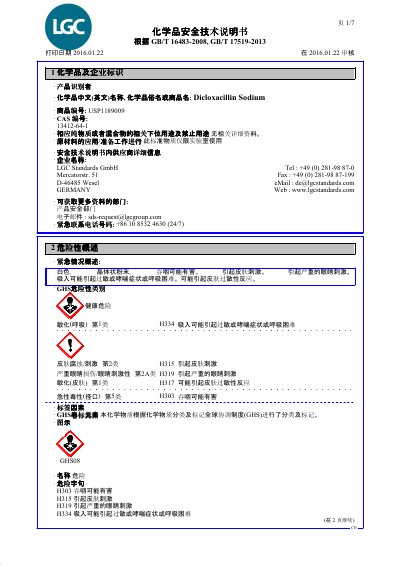
This is a Chinese chemical safety data sheet (化学品安全技术说明书) prepared by LGC Standards GmbH for Dicloxacillin Sodium, product code USP1189009, CAS number 13412-64-1. It follows GB/T 16483-2008 and GB/T 17519-2013 and states that the reference material is for laboratory use only.
The sheet lists GHS hazard classifications and statements (H303, H315, H317, H319, H334), precautionary and response statements, composition, first-aid and firefighting measures, spill handling, storage requirements, and contact control and personal protective equipment, including glove and respirator requirements. This manual is written in Chinese.
| CAS number | 13412-64-1 |
|---|---|
| Product code | USP1189009 |
| GHS hazard statements | H303, H315, H317, H319, H334 |
| Intended use | Laboratory use only |
Keep it in a tightly closed container in a cool, dry, well-ventilated place, away from fire and heat, and store it away from food.
Wear protective gloves, protective clothing, a face mask and a respirator, and avoid inhaling dust, smoke, gas, mist, vapour or spray.
It is classified for respiratory sensitization (H334), skin irritation (H315), serious eye irritation (H319), skin sensitization (H317) and acute oral toxicity category 5 (H303).
Move the person to fresh air, ensure a doctor is called, and place an unconscious person on their side for transport.