
ESP8266-S1 WiFi module is a low-power, cost-effective embedded wireless network control module that can meet the needs of IoT applications such as smart grids, building automation, security, smart homes, and remote healthcare.
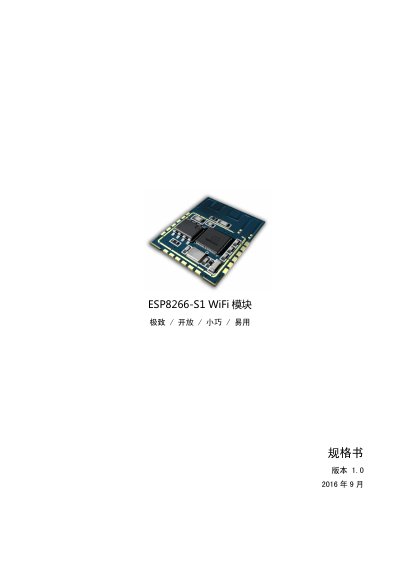
The ESP8266-S1 is a low-power, low-cost embedded wireless network control module developed by Shenzhen Huisirui Technology (汇思锐). Its core is the ESP8266, which integrates a Tensilica L106 ultra-low-power 32-bit MCU with a 16-bit reduced instruction mode running at 80 MHz or 160 MHz, along with 16 Mbit SPI Flash and an onboard antenna. The module supports the IEEE802.11 b/g/n standard and a complete TCP/IP stack, and is intended for applications such as smart grid, building automation, security, smart home and remote healthcare.
This specification (version 1.0, September 2016) gives the hardware parameters, pin definitions and interface functions for SPI, UART, I2C, I2S, PWM, IR and ADC, followed by electrical characteristics including power consumption in each mode and RF parameters. It also contains a schematic, a minimum system diagram, recommended PCB placement of the module and antenna, and routing suggestions for peripheral signals. This manual is written in Chinese.
| Operating voltage | 3.3 V (3.0 ~ 3.6 V) |
|---|---|
| Operating ambient temperature | -40 to 85 °C |
| CPU | Tensilica L106 32-bit MCU, 80 MHz and 160 MHz, RTOS support |
| Available RAM | 50 KB (approximately, Station mode) |
| Flash | 16 Mbit SPI Flash |
| Frequency range | 2.4 GHz ~ 2.5 GHz (2400 M ~ 2483.5 M) |
| Output power | +20 dBm in 802.11b mode |
| Current consumption | 80 mA average operating; 20 uA deep sleep hold current; off current below 5 uA |
| ADC | Built-in 10-bit high-precision ADC |
| Module dimensions | 18.6 mm * 15.0 mm * 3.05 mm |
| Maximum IO output current | 12 mA |
| Wireless network modes | Station / SoftAP / SoftAP + Station |
The module is powered from 3.3 V (VDD), with a working range of 3.0 to 3.6 V, and the external supply should be able to deliver more than 500 mA.
Average working current is about 80 mA, deep sleep hold current is 20 uA, and shutdown current is below 5 uA.
IO15 must be pulled low to GND and EN must be pulled high to 3.3 V for normal operation.
With the normal operating conditions met, pull IO0 low and reset the module; when the upgrade is finished, release IO0 and reset the module again.