
The Shanghai Lifefeng Biotechnology Co., Ltd. Endotoxin-free Plasmid DNA Small Extraction Kit uses the SDS/alkaline lysis method to release plasmid DNA, selectively adsorb plasmid DNA to remove the vast majority of endotoxins, high-salt ion elution, further phase separation to remove residual endotoxins, isopropanol precipitation to recover plasmid DNA, and the volume of DNA dissolution can be determined according to experimental needs. Taking parallel processing of 4 samples as an example, the operation time is about 100min.
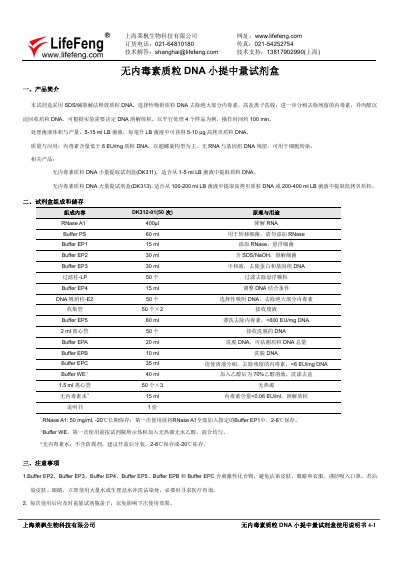
This is the instruction manual (使用说明书) for the 无内毒素质粒 DNA 小提中量试剂盒 (endotoxin-free plasmid DNA midi extraction kit, kit code DK312) from Shanghai Lifefeng Biotechnology Co., Ltd. (上海莱枫生物科技有限公司). The kit uses SDS/alkaline lysis to release plasmid DNA, selectively adsorbs the DNA to remove most endotoxin, uses high-salt elution and phase separation to remove residual endotoxin, and recovers the plasmid DNA by isopropanol precipitation.
The manual lists the kit components and storage conditions, precautions, the experimental principle behind each stage, preparation steps, and a 12-step operating protocol. Processing 5–15 ml of LB culture yields 5–10 μg of high-copy plasmid DNA per ml, with endotoxin below 6 EU/mg plasmid DNA, suitable for cell transfection. Processing four samples in parallel takes about 100 minutes. This manual is written in Chinese.
| Culture volume processed | 5–15 ml LB culture |
|---|---|
| Plasmid DNA yield | 5–10 μg per ml of LB culture (high-copy plasmid) |
| Endotoxin content | Below 6 EU/mg plasmid DNA |
| Operation time | About 100 min for 4 samples in parallel |
| Endotoxin-free water | Endotoxin <0.06 EU/ml, no preservatives |
| RNase A1 concentration | 50 mg/ml, store at -20 °C long term |
| Kit size | DK312-01, 50 preparations |
The kit processes 5–15 ml of LB culture and yields 5–10 μg of high-copy plasmid DNA per ml of culture.
Yes. Endotoxin is below 6 EU/mg plasmid DNA, the DNA is mostly supercoiled with no RNA or genomic DNA residue, and it can be used for cell transfection.
Processing four samples in parallel takes about 100 minutes.
Store RNase A1 at -20 °C long term; before first use, add all of it to the specified Buffer EP1 and then store at 2–8 °C.