
This document is a guide to fiber technology, describing the features and benefits of fiber technology.
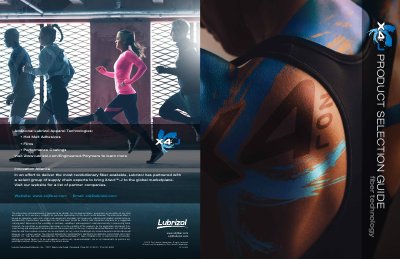
This product selection guide presents X4zol-J, a thermoplastic polyurethane (TPU) elastomeric monofilament from Lubrizol Advanced Materials, Inc. The fiber is produced by melt extrusion without solvents, and the document states that this gives a finer, stronger monofilament with superior stretch compared with traditional spandex.
The guide lists fabric benefits such as breathability, balanced 360º stretch, chlorine and UV resistance and recyclability, together with compatible yarns (nylon, cotton, wool, polyester), fabric construction and apparel application examples, knitting processes, and the available deniers and colors. A note gives a maximum recommended dyeing temperature of 115°C, and contact details for custom deniers and colors are included.
| Material | Thermoplastic polyurethane (TPU) elastomeric monofilament |
|---|---|
| Production process | Melt extrusion, solvent free |
| Available deniers | 20D, 40D, 70D, 140D (UV Bright); 360D, 1080D (WHT Semi-Dull) |
| Maximum recommended dyeing temperature | 115°C |
| Compatible yarns | Nylon, cotton, wool, polyester |
It is a thermoplastic polyurethane (TPU) elastomeric monofilament that is produced by melt extrusion without solvents.
Nylon, cotton, wool and polyester are listed as compatible yarns.
The guide states a maximum recommended dyeing temperature of 115°C.