
The EPHY-MESS GmbH temperature sensor PR-SPA-EX-NWT is an intrinsically safe temperature sensor that can be installed in or outside of motor slots.
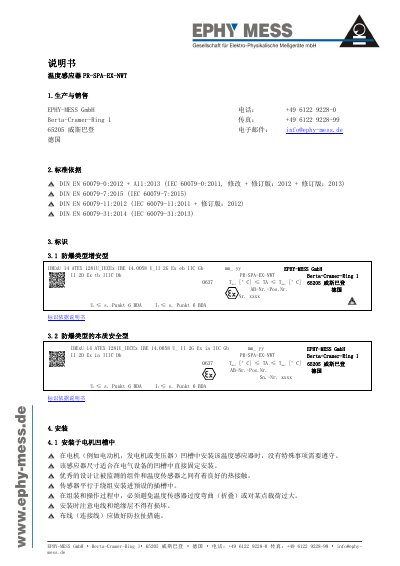
This Chinese-language manual covers the EPHY-MESS PR-SPA-EX-NWT temperature sensor, an explosion-protected sensor marked for use in gas and dust atmospheres. It lists the standards the sensor is based on, the ATEX and IECEx certificate numbers, and the exact marking text for the increased-safety (Ex e / Ex tb) and intrinsic-safety (Ex ia) versions.
The document explains installation in motor slots and outside them, calculation of self-heating, the permissible electrical values for Ex e and Ex i use, and how to connect the sensor. It also includes technical parameters for the different sensor variants (resistance sensors, thermocouples, KTY sensors, PTC thermistors), the type designation key, the series-name code and the color codes for lead connection. This manual is written in Chinese.
| Explosion protection marking | II 2G Ex ia IIC Gb / II 2D Ex ia IIIC Db and II 2G Ex eb IIC Gb / II 2D Ex tb IIIC Db |
|---|---|
| Certificates | IBExU 14 ATEX 1281 U; IECEx IBE 14.0058 U |
| Ambient temperature, resistance sensors (Pt/Ni/Cu) | -60 °C to +180 °C |
| Ambient temperature, KTY83 | -55 °C to +175 °C |
| Ambient temperature, KTY84 | -40 °C to +180 °C |
| Ambient temperature, PTC thermistor | -45 °C to +180 °C |
| Rated resistance at 0 °C | 5 … 2000 Ω |
| Recommended measuring current | 0.3–1 mA (chip measuring elements); 0.2–2.0 mA (double winding) |
| Self-heating coefficient | 0.4 K/mW at 0 °C (Pt/Ni/Cu and KTY) |
| Maximum voltage UI, double winding | DC 65 V (Ex e); DC 32 V (Ex i) |
| Maximum voltage, thermocouple (TE) | 1.5 V |
| Test voltage | 0.5 kV / 50 Hz, 1 min (sensor and leads) |
| Wire cross-section | ≥ AWG 30 |
It is marked for increased safety and for intrinsic safety, in gas and dust atmospheres: II 2G Ex eb IIC Gb / II 2D Ex tb IIIC Db and II 2G Ex ia IIC Gb / II 2D Ex ia IIIC Db.
The sensor is sized for direct mounting in the slot of electrical equipment and is placed parallel to the winding in the provided slot; excessive bending or point loads on the sensor must be avoided.
Yes. In that case the sensor is in direct contact with the explosive gas, so its self-heating and the resulting surface temperature rise must be taken into account.
0.3 to 1 mA for measuring elements with a chip, and 0.2 to 2.0 mA for versions with a double winding.