
The document is about the instruction manual of a certain heater, which introduces the installation, operation and maintenance methods of the heater.
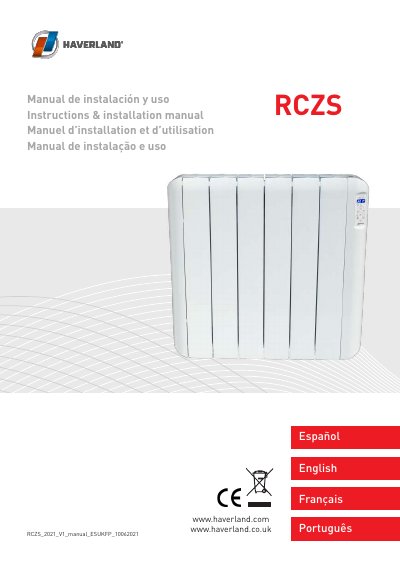
The Haverland RCZS is a wall-mounted thermal emitter that must be fixed firmly to a stable, level wall. The manual covers general warnings, installation, operation, control panel use, thermostat and clock settings, heating modes, time schedules, functions, and maintenance.
The document includes Spanish, English, French, and Portuguese sections. It describes anti-freeze mode at 7°C, manual and programmed heating modes, the open-windows function, ITCS, display and keyboard lock options, and the 2-hour boost feature.
| Power ratings (W) | 600, 900, 1200, 1500, 1800 |
|---|---|
| Minimum clearance from any material | 15 cm |
| Anti-freeze temperature | 7°C |
| Mounting | Wall-mounted; not for recessing |
| Thermal fluid | Special thermal fluid |
Start it in a ventilated place for 2 or 3 hours.
No. The manual states that the emitter must be fixed to the wall and must not be recessed.
It maintains the room temperature at 7°C.
A minimum distance of 15 cm is required.