
This document describes the potential hazards of manual pallet jacks and how to use personal protective equipment (PPE) to reduce the risk of these hazards.
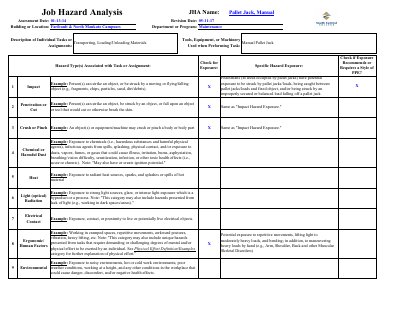
This document is a Job Hazard Analysis (JHA) form titled "Pallet Jack, Manual" for the Faribault & North Mankato Campuses Maintenance department or program (01-13-14). It lists hazard types associated with the task with check boxes for exposure categories such as impact, penetration or cut, crush or pinch, heat, electrical contact, ergonomic/human factors and environmental hazards, and it records the assessment date, building or location and revision date (05-11-17). The certification page states that a hazard assessment was conducted under 29 CFR 1910.132 (d) and South Central College's related safety programs and policies.
The second page sets out personal protective equipment requirements, including safety shoes required whenever operating manual pallet jacks, plus other control measures for impact, penetration, cut, crush and pinch hazards and ergonomic hazards. It gives operating guidance for manual pallet jacks: push rather than pull, start and stop gradually, keep the control handle in the neutral position, keep the load uphill on inclines, keep one inch of clearance between the floor and load, and store jacks with the forks lowered away from pedestrian traffic.
| Required footwear | Safety shoes whenever operating manual pallet jacks |
|---|---|
| Load clearance for moving | One inch between the floor and load/pallet |
| Brakes | Manual pallet jacks do not have brakes |
It should be pushed; pulling a pallet jack places major strain on the body and can cause shoulder injuries.
Safety shoes are required whenever manual pallet jacks are operated.
Personnel must be trained by an authorized college trainer before operating pallet jacks.
It must be stored in areas not exposed to pedestrian traffic with the forks lowered.