
JH3S-X JH5SL-X FREE FLOAT STEAM TRAPS JH3S-X/JH5SL-X INSTRUCTION MANUAL Keep this manual in a safe place for future reference
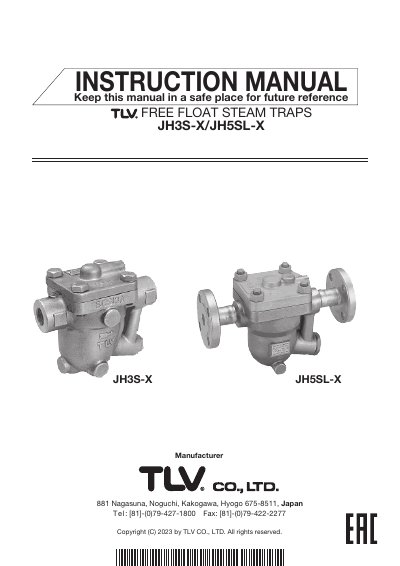
The manual covers TLV JH3S-X/JH5SL-X free float steam traps. It describes inline repairable JHS-X series steam traps with a thermostatic air vent (X-element), suitable for applications with small-to-large capacities and pressures up to 3.2 MPaG (450 psig), such as heat exchangers, process heaters and coils. The traps discharge condensate continuously and automatically at a temperature slightly lower than saturation temperature.
The document presents safety considerations, specifications, configuration, an exploded view, proper installation, piping arrangement, inspection and maintenance, and disassembly/reassembly. It also includes parts inspection points and tightening torque tables.
| Pressure capability | Up to 3.2 MPaG (450 psig) |
|---|---|
| Air vent | Thermostatic air vent (X-element) |
| Connection types | Screwed and socket weld |
The manual states pressures up to 3.2 MPaG (450 psig).
Operational inspections should be performed at least twice per year, or as called for by trap operating conditions.
Check the float for deformation, damage, oil film or water inside.
Close the inlet and outlet isolation valves and wait until the trap has cooled completely.