
This document is about automotive fault diagnosis service, it introduces how to use voltage drop to diagnose circuit faults.
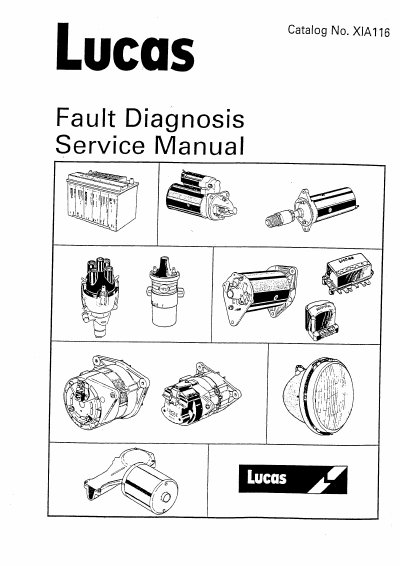
The Lucas Fault Diagnosis Service Manual, Catalog No. XlAl16, sets out a logical sequence of tests for automotive electrical equipment. It begins with battery testing and service, then covers starter systems, coil ignition, dynamos and control boxes, lighting, wiper motors, alternators and direction indicator circuits.
The introduction explains fault diagnosis as locating faults while equipment is still in situ and describes testing for voltage drop under load. It lists minimum test equipment including a D.C. voltmeter, D.C. ammeter, hydrometer, heavy duty battery discharge tester and ohmmeter.
| Acceptable voltage drop for most circuits | 10% of system voltage; 1.2 volts on a 12 volt system |
|---|---|
| Maximum voltage drop, starter circuit | 0.5 volts |
| Normal battery charge rate | About one-tenth of A/H capacity at the 10 hour or 20 hour rate |
| Hydrometer float calibration | 1.130 to 1.300 |
It is the method of locating faults while the electrical equipment is still in situ, aiming to find faults accurately and in the shortest time with minimum equipment.
The maximum voltage drop allowed is 0.5 volts.
Only distilled water or de-ionised water should be added to replace electrolyte lost by evaporation.
It is approximately one-tenth of the battery's A/H capacity at the 10 hour or 20 hour rate.