
China High-Tech Corporation actively applied for the second batch of the Ministry of Education's Education-Industry Cooperation and Synergistic Education Program in 2020. The construction content of the application includes new engineering, new medical, new agricultural, new liberal arts construction projects, teaching content and curriculum system reform projects, teacher training projects, and practical conditions and practice base construction projects, a total of four major categories of projects.
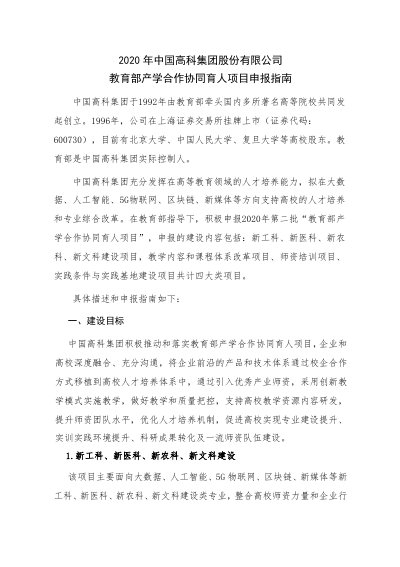
China High-Tech Group, founded in 1992 under the Ministry of Education and listed on the Shanghai Stock Exchange (600730), publishes application guidelines for the 2020 second batch of the Ministry of Education's Industry-University Cooperation and Collaborative Education Program. The program aims to integrate enterprise technology resources into university talent cultivation systems across big data, artificial intelligence, 5G IoT, blockchain, and new media fields.
The guidelines detail four project categories: new engineering/medical/agricultural/liberal arts construction (3 projects, 150,000 RMB), teaching content and curriculum reform (5 projects, 250,000 RMB), faculty training (5 projects, 100,000 RMB), and practice condition/base construction (1 project, ≥200,000 RMB hardware/software). Eligibility requirements, construction deliverables, and application procedures are specified for each category, targeting IT-related undergraduate programs at Chinese universities. This manual is written in Chinese.
The program aims to support talent cultivation and professional reform in fields such as big data, artificial intelligence, 5G IoT, blockchain, and new media through industry-university collaboration.
The 2020 second batch includes 14 projects across four categories: new engineering construction, teaching content and curriculum reform, faculty training, and practice conditions and practice base construction.
The program provides 50 万元人民币 in funding and no less than 20 万元 in software and hardware support.
Applicants must be program leaders or core teachers with associate professor title or above and significant teaching achievements.