
Adhesive-resistant material and its hard anti-stick coating
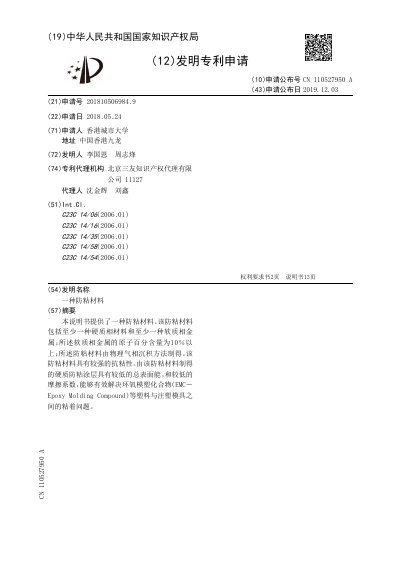
This is the published Chinese patent application CN 110527950 A, filed by City University of Hong Kong (application number 201810506984.9, filing date 2018.05.24, publication date 2019.12.03). It describes an anti-stick material made of at least one hard phase material and at least one soft phase metal, with the soft phase metal at 10 atomic percent or more. The soft phase metal grains are embedded in the hard phase grains to form a fine-grained structure; nickel and transition metal nitrides such as CrN, Cr2N, MoN, Mo2N and TaN are named, and the material is produced by physical vapor deposition.
The document also claims an anti-stick coating with a total surface energy of 30 mN/m or less, built from a metal adhesion layer, a nitride intermediate layer and a Cr-Mo-Ni-N hard anti-stick layer, plus an anti-stick structure combining the coating with a substrate. A preparation method using plasma-enhanced magnetron sputtering with closed magnetic field, pulsed power supplies, a linear gas ion source and optional optical emission monitoring is described, together with the sputtering equipment. The stated purpose is to reduce sticking between epoxy molding compound (EMC) and injection molds, where the text notes adhesion, wear and corrosion of packaging tools. This manual is written in Chinese.
| Soft phase metal content | 10 atomic percent or more |
|---|---|
| Nickel content | 10–30 atomic percent |
| Molybdenum content | 5–20 atomic percent |
| Total surface energy of hard anti-stick coating | ≤30 mN/m |
| Total surface energy of Cr-Mo-Ni-N coating | 20–30 mN/m |
| Sputtering power density | 1–5 W/cm2 |
| Substrate negative bias | 40–120 V |
| Substrate rotation speed | 1–10 rpm |
| Substrate temperature | Room temperature to 500 °C |
| Heat treatment | 200–500 °C for 1–3 hours |
It contains at least one hard phase material and at least one soft phase metal, with the soft phase metal at 10 atomic percent or more.
The hard anti-stick coating has a total surface energy of 30 mN/m or less; the Cr-Mo-Ni-N coating is given as 20–30 mN/m.
It is intended to solve sticking between epoxy molding compound and injection molds.
By plasma-enhanced magnetron sputtering with closed magnetic fields between adjacent targets, driving the targets with pulsed power and supplying reactive gas through a linear gas ion source.