
LCM1-1278S is a high-performance, low-power, long-range micro-power wireless transparent module. It automatically calculates the spread spectrum and performs leading CRC error correction without changing any data and protocol of the user. It adopts a half-duplex transparent transmission mechanism to realize wireless serial reception and transmission instead of wired transmission. It is suitable for low-power applications such as data acquisition.
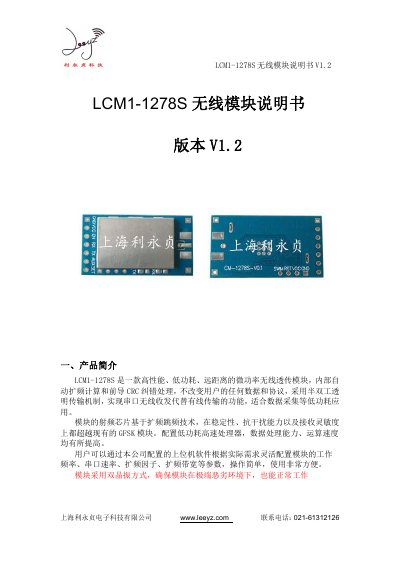
The LCM1-1278S is a high-performance, low-power, long-range wireless transparent transmission module based on LoRa spread-spectrum technology. It operates in the 420–450 MHz band (China) with configurable frequency, spreading factor, bandwidth, and transmit power up to 20 dBm. The module provides a TTL serial interface, supports sleep/wake functions, collision avoidance, and low-voltage detection, and is designed for stable operation in harsh environments from -40°C to 85°C.
Configuration can be done via a PC upper-computer software or through AT commands sent from a host MCU. The module offers three operating modes: transparent transmission, central (star network coordinator), and node (star network endpoint). Detailed pin definitions, electrical characteristics, and AT command structure are provided for integration. This manual is written in Chinese.
| Modulation | LoRa spread spectrum |
|---|---|
| Frequency range | 420–450 MHz (China), other bands customizable |
| Transmit power | 1 dBm to 20 dBm (7 levels) |
| Receive sensitivity | -143 dBm at 50 bps |
| Transmission distance | 3000–5000 meters |
| Antenna connection | External SMA, spring, or suction cup antenna |
| Data interface | TTL level, TxD/RxD |
| Serial baud rate | 1200–115200 bps |
| Serial parity | None, Even, Odd |
| Input voltage | DC 3.3 V |
| Max transmit current | ≤140 mA at 20 dBm |
| Max receive current | <16 mA |
| Sleep current | <1.5 µA (without LDO) |
| Operating temperature | -40°C to +85°C |
| Dimensions | 34.2 × 18.4 × 4 mm |
The module operates in the 420–450 MHz range for China, with other frequency bands available for customization.
Seven levels: 4, 7, 10, 13, 14, 17, and 20 dBm.
Baud rates from 1200 to 115200 bps, 7 or 8 data bits, none/odd/even parity, and 1 or 2 stop bits.