
The XC Ⅱ classifying and concentrating hydraulic cyclone is a water hydraulic cyclone developed by Xinhai Company. Its feed port adopts a spiral feeding method, which reduces the turbulence degree caused by the sudden divergence of the material entering the cyclone, making the fluid motion in the cyclone more stable, and improving the separation performance of the cyclone.
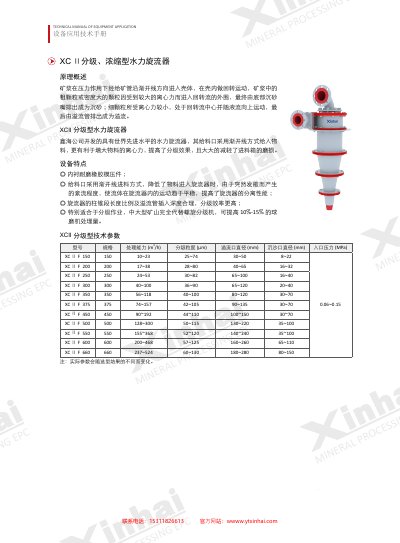
Xinhai developed the XCⅡ classifying and concentrating hydraulic cyclone. In the classifying type, slurry enters the shell under pressure through an involute feed inlet; coarse or dense particles are thrown to the outer rotating flow and discharged through the bottom sand nozzle, while fine particles rise and leave through the overflow pipe. The listed features include molded wear-resistant rubber liners, an involute feed that reduces turbulence and feed-box wear, and a column-cone length ratio and overflow pipe insertion depth intended to improve classification efficiency.
The XCⅡN concentrating type is described for tailings dry discharge, with a distinct feed inlet, a more suitable cylinder height and cone angle, and further optimized overflow pipe insertion depth; the text states an underflow concentration up to 75%. The document provides technical parameter tables for XCⅡF 150–660 and XCⅡN 150–450, plus exploded and structure diagrams with numbered parts. This manual is written in Chinese.
| XCⅡF 150 processing capacity | 10~23 m³/h |
|---|---|
| XCⅡF 150 classification particle size | 25~74 μm |
| XCⅡF 150 inlet pressure | 0.06~0.15 MPa |
| XCⅡN 150 processing capacity | 11~17 m³/h |
| XCⅡN underflow concentration | up to 75% |
| Ball mill throughput increase with XCⅡ classifying type | 10% -15% |
Slurry enters the shell under pressure through the feed pipe in an involute direction; coarse or dense particles move to the outer rotating flow and exit through the bottom sand nozzle, while fine particles rise in the center flow and exit through the overflow pipe.
The document states an underflow concentration up to 75%.
It uses an involute feed inlet.
The processing capacity is 10~23 m³/h.