
Animal Hard Tissue Active Mitochondria Separation Kit Product Manual, Suitable for Preparation of Active Mitochondria from Animal Hard Tissues (Heart or Muscle). The preparation has a high yield and activity preservation, which can be used for mitochondrial enzyme activity, cell apoptosis, signal transduction, energy metabolism, proteomics and pathological physiology.
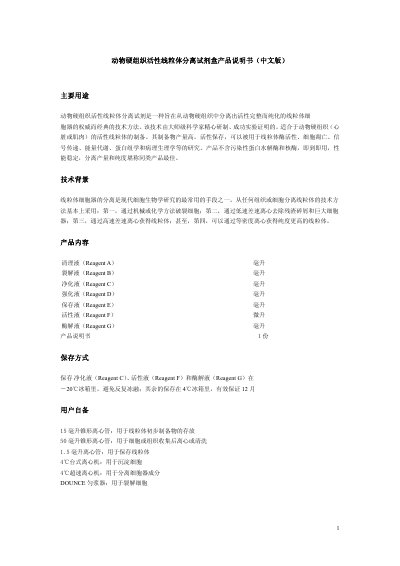
This manual describes a reagent kit for separating intact, active and purified mitochondria from animal hard tissues (heart or muscle). The prepared mitochondria are suitable for studies of mitochondrial enzyme activity, apoptosis, signal transduction, energy metabolism, proteomics and pathophysiology; the kit contains no contaminating proteases or nucleases.
The manual lists the kit contents and storage conditions, the equipment the user must provide, and two protocols: a tissue homogenization method and a chemical treatment method, each with centrifugation steps at 1000 g, 1500 g and 10000 g. Precautions, troubleshooting guidance and quality standards are also included. This manual is written in Chinese.
| Number of preparations | 10 procedures with 1 g of animal tissue, or 50 procedures with 200 mg of animal tissue |
|---|---|
| Storage | Reagent C, Reagent F and Reagent G at -20 °C (avoid repeated freeze-thaw); remaining reagents at 4 °C; shelf life 12 months |
| Mitochondrial yield | 1 g of animal hard tissue typically contains 1 to 10 mg of mitochondrial protein |
| Centrifugation conditions | 1000 g for 2 minutes (washes), 1500 g for 10 minutes (remove nuclei and undissolved cells), 10000 g for 10 minutes (mitochondrial pellet) |
| Recommended tissue amount | 1 g of tissue requires 5 ml of cleaning solution (Reagent A) for washing |
| Operating temperature | All procedures must be carried out strictly at 4 °C or below |
It is intended for animal hard tissues, specifically heart or muscle, for preparing active mitochondria.
It supports 10 procedures with 1 g of animal tissue or 50 procedures with 200 mg of animal tissue; reagent volumes scale proportionally with tissue weight.
Activity is measured by citrate synthase activity, oxidative phosphorylation, or the cytochrome absorption peak spectrum; membrane integrity is checked by cytochrome c oxidase activity and JC fluorescence staining.
Yes; lowering the 10000 g centrifugation speed to 3000-8000 g improves the purity of the crude mitochondrial preparation but reduces the yield.