
M5 Hiper“转必得”高难阳离子转染试剂 is a new type of efficient cationic polymer. It can interact with nucleic acids to form a complex that transports nucleic acids into eukaryotic cells, which is suitable for most eukaryotic cell transfection.
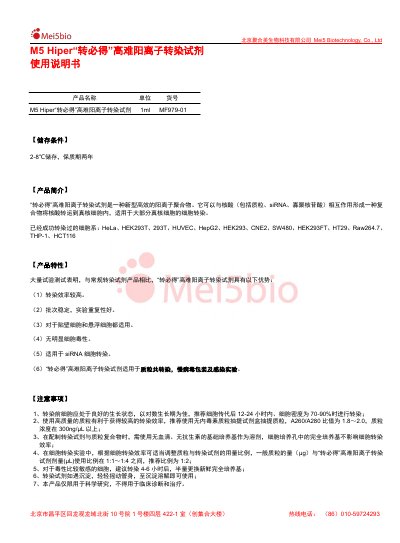
M5 Hiper is a cationic polymer transfection reagent that forms complexes with nucleic acids, including plasmids, siRNA, and oligonucleotides, for delivery into eukaryotic cells. It is described as suitable for most eukaryotic cells, including adherent and suspension cells, with no obvious cytotoxicity.
The manual provides precautions, recommended plasmid and reagent ratios, and step-by-step protocols for adherent cells, suspension cells, siRNA transfection, and lentivirus packaging and infection. It also includes dosage tables for common culture vessels and states that the product is for research use only. This manual is written in Chinese.
| Catalog number | MF979-01 |
|---|---|
| Volume | 1 ml |
| Storage temperature | 2-8°C |
| Shelf life | 2 years |
| Recommended plasmid-to-reagent ratio | 1:1 to 1:4 (recommended 1:2) |
| Recommended cell density | 70-90% |
| Recommended plasmid A260/A280 | 1.8-2.0 |
| Recommended plasmid concentration | at least 300 ng/μL |
Store the reagent at 2-8°C; its shelf life is two years.
Yes, it is suitable for siRNA cell transfection.
Yes, it is suitable for plasmid co-transfection, lentivirus packaging, and infection experiments.
The ratio is generally 1:1 to 1:4, with 1:2 recommended.