
This is a technical guide about innovative buildings in Austria.
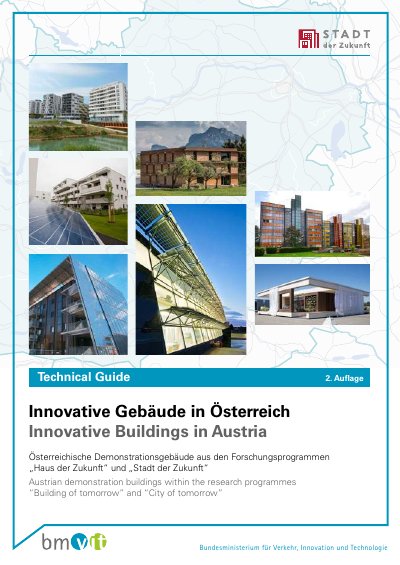
This guide, published by the Austrian Federal Ministry for Transport, Innovation and Technology (BMVIT), presents pioneering new buildings and renovation projects that were designed and built on the basis of results from the research programmes "Building of Tomorrow" and "City of Tomorrow". It gives an overview of demonstration projects already built and under construction, with status as of 2017 (second edition, Vienna, April 2017).
The projects are grouped by region: western Austria (Vorarlberg, Tyrol, Salzburg), central Austria (Upper Austria, Carinthia, Styria) and eastern Austria (Lower Austria, Burgenland, Vienna). Each entry carries a project number, address and data box, and QR codes link to further information on the online platform "NachhaltigWirtschaften.at". A glossary and key to abbreviations close the volume. This manual is written in German.
The projects were conceived and built on the basis of results from the research programmes "Building of Tomorrow" and "City of Tomorrow".
According to the introduction, 40 % of final energy consumption is associated with buildings.
The EU directive on the energy performance of buildings commits the public sector to erect new public buildings as nearly zero-energy buildings by 2019.
QR codes in the guide link directly to further content and information on the projects on the web platform "NachhaltigWirtschaften.at".