
A green fluorescent ink for fluorescent pens is disclosed, which comprises the following weight fractions of raw materials: edible colorant 6 to 15 parts, nano-sulfur zinc 1 to 3 parts, nano-zinc oxide 1 to 3 parts, glycerol 3 to 6 parts, propylene glycol 3 to 7 parts, ethanolamine 2 to 8 parts, phosphate 5 to 10 parts, non-ionic surfactants 0.1 to 0.3 parts, anionic surface active agents 0.1 to 0.3 parts, and deionized water 15 to 20 parts. The advantages of the invention are as follows: a green fluorescent ink for fluorescent pens, which abandons traditional fluorescent agents, adopts nano-inorganic materials, is safe, environmentally friendly, non-polluting, and harmless to human health.
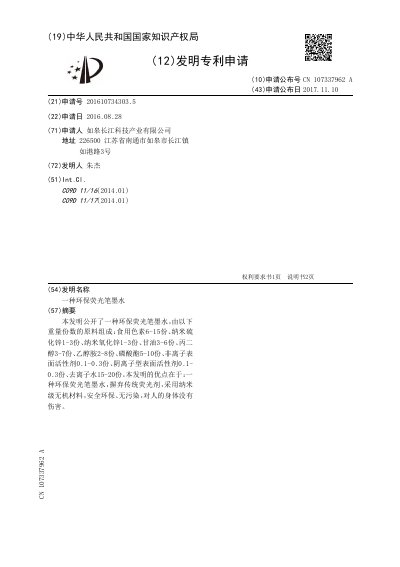
Patent application CN 107337962 A, filed by Ruchang Changjiang Technology Industry Co., Ltd., describes an eco-friendly fluorescent pen ink. The formulation replaces traditional fluorescent agents with nano-scale inorganic materials such as nano zinc sulfide and nano zinc oxide, combined with food-grade pigment, glycerin, propylene glycol, ethanolamine, phosphate ester, non-ionic and anionic surfactants, and deionized water.
The document explains that conventional fluorescent inks contain fluorescent compounds that may be toxic and potentially carcinogenic. The proposed ink avoids these substances by using nano-level inorganic materials, which are described as safe, environmentally friendly, and non-harmful to the human body. Three specific embodiments with detailed ingredient proportions are provided. This manual is written in Chinese.
| Food-grade pigment | 6-15 parts by weight |
|---|---|
| Nano zinc sulfide | 1-3 parts by weight |
| Propylene glycol | 3-7 parts by weight |
| Ethanolamine | 2-8 parts by weight |
| Phosphate ester | 5-10 parts by weight |
| Non-ionic surfactant | 0.1-0.3 parts by weight |
| Anionic surfactant | 0.1-0.3 parts by weight |
| Deionized water | 15-20 parts by weight |
Some fluorescent substances are toxic and contain potentially carcinogenic components, making long-term use harmful to the human body.
It is described as a pen used for making marks.
It uses relatively thick, light ink to cover key parts.
It uses nano-scale inorganic materials.