
This manual provides scientific and practical knowledge to guide the management and implementation of coral reef rehabilitation.
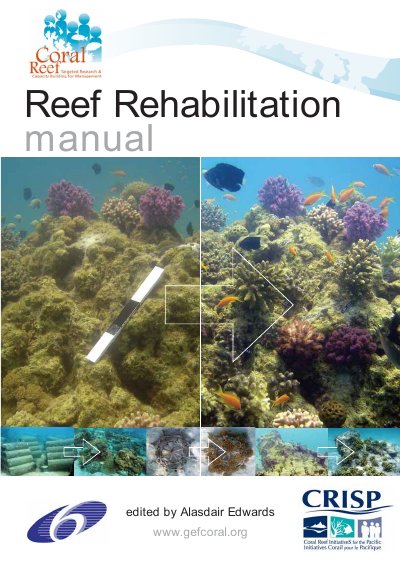
The Reef Rehabilitation Manual, edited by Alasdair J. Edwards and published in 2010 by the Coral Reef Targeted Research & Capacity Building for Management (CRTR) Program, provides detailed advice on how to carry out coral reef rehabilitation in a responsible and cost-effective manner. The text states that it is intended to complement the Reef Restoration Concepts & Guidelines and that the two booklets should be used together.
The manual covers the objectives and scope of reef rehabilitation, the steps in planning a rehabilitation project, managing risks in reef restoration projects, constructing and managing nurseries for asexual rearing of corals, rearing coral larvae, methods of coral transplantation and evaluating the costs of restoration. It ends with lessons learnt from past reef-rehabilitation projects and ten case studies from sites in Indonesia, Tuvalu, the Maldives, Thailand, Israel, Puerto Rico, Japan, Fiji, Mexico and the Philippines.
The manual aims to reduce the proportion of reef rehabilitation projects that fail, to introduce protocols for methods that could repopulate larger areas of degraded reef, to highlight planning factors that minimise the risk of failure, and to underline the current limitations of reef rehabilitation.
It defines rehabilitation as the act of partially or, more rarely, fully replacing structural or functional characteristics of an ecosystem that have been diminished or lost.
Because corals are the keystone species that give structure and topographic complexity to coral reef ecosystems, and they are also among the taxonomic groups most vulnerable to global climate change.
It uses the definition of ecological restoration as the process of assisting the recovery of an ecosystem that has been degraded, damaged, or destroyed.