
The manual covers the experimental content of food analysis, including the determination of chemical components and physical components.
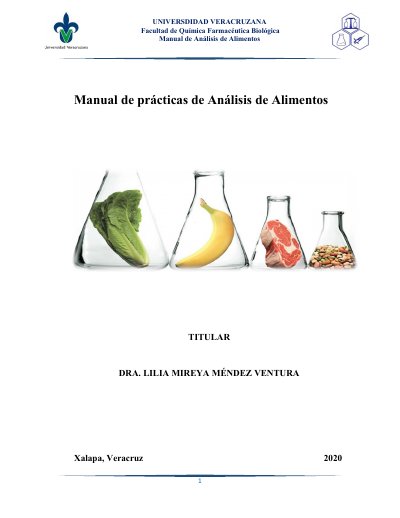
This is the Manual de Análisis de Alimentos (Food Analysis Manual) of the Facultad de Química Farmacéutica Biológica at Universidad Veracruzana, Xalapa, Veracruz, 2020, with Dra. Lilia Mireya Méndez Ventura as the titular. The opening pages state the competency unit, the teaching and learning strategies, the educational supports, the performance evaluation criteria with percentages, the accreditation rules and a list of laboratory safety rules, followed by a table of contents of five units plus recommendations and annexes.
Unit 1 covers introduction to food analysis, sampling, definition and classification of analytical methods, selection of a method, characteristics of samples, sample collection and preparation, sample preservation, proximal analysis, laboratory techniques and general methods of analysis. Later units deal with cereals and legumes, meats and meat derivatives, milk, and wines and alcoholic beverages. The text describes proximal analysis as moisture or volatile substances at 105 °C, ether extract or crude fat, ash or mineral material, crude fiber, crude protein and nitrogen-free extract. This manual is written in Spanish.
It includes moisture or volatile substances at 105 °C, ether extract or crude fat, ash or mineral material, crude fiber, crude protein and nitrogen-free extract.
Students must have attended at least 80% of the classes and presented each performance evidence with sufficiency.
The grading scale runs from 2 to 10, and the minimum passing grade is 6.
The units cover cereals and legumes, meats and meat derivatives, milk, and wines and alcoholic beverages.