
This document introduces the properties of epoxy resins and some of their applications in industry, such as industrial adhesives, coatings, and reinforced plastics.
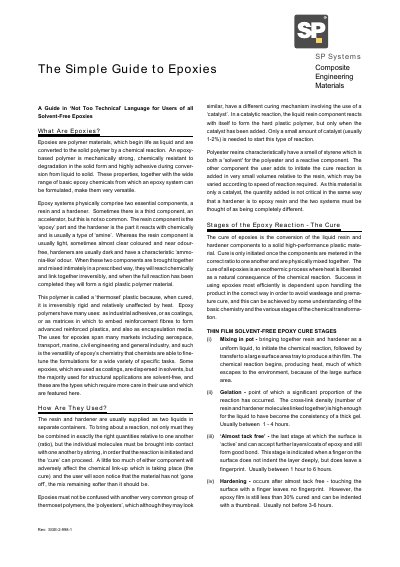
"The Simple Guide to Epoxies" (Rev: SGE-2-998) from SP Systems Composite Engineering Materials is a plain-language guide for users of all solvent-free epoxies. It explains what epoxies are, how the two-component resin and hardener system reacts to form a thermoset plastic, and how epoxies differ from polyester resins, which cure with a catalyst instead of a hardener.
The guide sets out the stages of the epoxy cure, from mixing and gelation through tack-free, hardening, sanding and loading times to full cure, and lists practical rules for users: storing and using the products warm, measuring resin and hardener accurately in the correct mix ratio, and reading the product data sheet for each specific system. It also describes metering methods such as graduated syringes and non-calibrated mini-pumps.
| Gelation time | Usually between 1 - 4 hours |
|---|---|
| Almost tack free time | Usually between 1 hour to 6 hours |
| Hardening time | Usually not before 3-6 hours |
| Earliest sanding time | Usually 8-24 hours |
| Full cure | Usually after a minimum of one week |
| Usable storage temperature | Any temperature above 15°C; 18-25°C ideal |
| Reaction rate vs temperature | Doubles for every 10°C rise |
| Minimum curing temperature | Not lower than 12-15°C |
| Non-calibrated mini-pump dispense volume | Approx. 7cc per stroke |
An epoxy system comprises a resin and a hardener; sometimes a third component, an accelerator, is added but this is not common.
Polyesters cure with a small amount of catalyst (usually 1-2%) that starts a reaction of the resin with itself, while epoxies require resin and hardener mixed in an exact ratio, so the two systems are completely different.
Read the data sheet supplied with the product; ratios are usually given by volume (e.g. 5:2 resin to hardener) and some systems also give a weight ratio, which is nearly always different.
An electric hot air gun (paint-stripper type) can aid application in cold conditions down to 5°C, but heat should only be applied to the surfaces to be bonded or coated, in a limited number of short bursts.