
This manual covers the basic biosecurity measures and welfare requirements of buffalo. It does not cover the husbandry or nutritional management of buffalo.
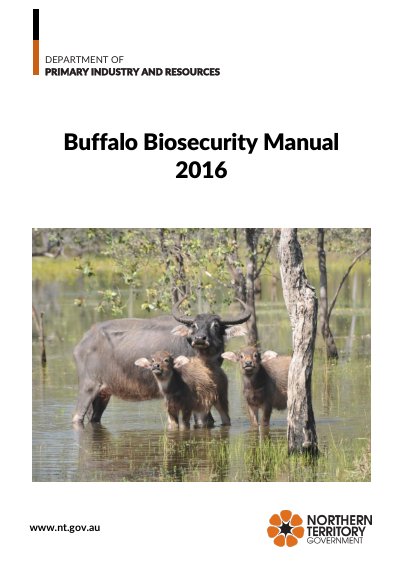
This 2016 Buffalo Biosecurity Manual was produced by the Northern Territory Department of Primary Industry and Resources. It covers basic biosecurity measures and welfare requirements of buffalo and states that it does not cover buffalo husbandry or nutritional management.
The document includes record keeping, staff training, carcass disposal, introduction of new animals, restricted animal materials, and food quality and supply. It also covers welfare and land transport standards, dehorning and tipping, movement requirements, NLIS tags, brands, waybills, cattle tick inspection and treatment, handling and management, several named diseases and a buffalo biosecurity checklist.
It covers the basic biosecurity measures and welfare requirements of buffalo; it does not cover buffalo husbandry or nutritional management.
The maximum time off water is 36 hours, followed by a minimum spell of 24 hours.
A buffalo is not fit to load if it cannot walk bearing weight on all legs, is severely emaciated, visibly dehydrated, shows severe injury or distress, or is blind in both eyes, among other conditions.
The transporter must have a record accessible at the roadside specifying when the buffalo last had access to water, inspections and welfare concerns or actions, and emergency contacts.