
This document provides guidance on how to conduct proper landfill operations at NEDS. Topics include planning and design, access road, landfill method, landfill equipment, working face, cover material, cover soil type, gas removal pipe, landfill procedure, and environmental management.
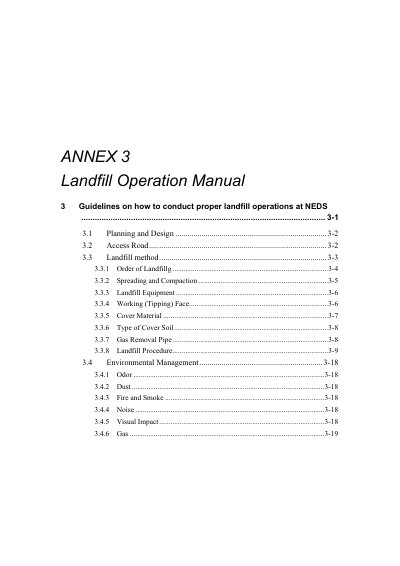
This document is Annex 3 of a JICA project for strengthening solid waste management capacity in Ulaanbaatar City, Mongolia, prepared by Kokusai Kogyo Co., Ltd. and dated July 2010. It sets out practical guidelines for proper landfill operations at NEDS, covering planning and design, access roads, landfill methods, order of filling, spreading and compaction, equipment, working face, cover material, gas removal pipes, and environmental management.
The guidelines recommend landfilling from downhill upwards at NEDS and keeping the working face small. They describe spreading waste in layers of about 30 to 50 cm, compacting with regular equipment passes, maintaining a lift of about 2 m with a maximum of 3 m, and using a 3:1 slope gradient when pushing up. Environmental sections address odor, dust, fire and smoke, noise, visual impact, and gas.
| Waste layer thickness | About 30 to 50 cm |
|---|---|
| Lift height | About 2 m, maximum 3 m |
| Recommended slope gradient | 3:1, about 20 degrees |
| Working face size | No greater than 30 m by 50 m for large landfills; 20 m by 20 m for smaller operations |
| Cover soil thickness | 20 cm |
The guidelines recommend landfilling from downhill upwards at NEDS.
Waste should be spread in thin layers of about 30 to 50 cm, with regular compaction passes between layers.
A slope gradient of 3:1, about 20 degrees, is recommended for pushing up and compacting the slope.
A large landfill should keep its tipping face no greater than 30 m by 50 m, while smaller operations should aim for 20 m by 20 m.