
This document is the manual for PV100 process viscometer, including PV100-DM and PV100-TM two versions
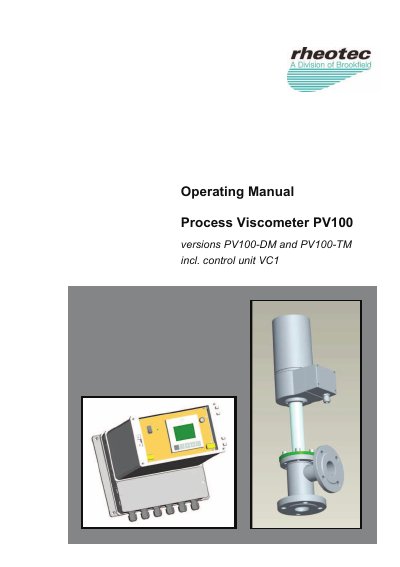
This operating manual covers the RheoTec PV100 process viscometer system, version 3.4 E, in its two basic variants: the PV100-TM immersion-type viscometer for measuring the viscosity of liquids in containers, and the PV100-DM flow-through viscometer for continuous measurement of flowing liquids in pipelines. Both versions are supplied with a control unit VC1, built around the KS98 controller, which processes viscosity, shear rate, shear stress, temperature and temperature-compensated viscosity values and displays them.
The manual gives the technical data of the system, including measuring ranges for the MH10, MH16, MH16G and MHSZ measuring heads, static errors, installation and operating conditions, and the principle of measurement. It then describes the instrument, assembly and initial operation, measurement and evaluation, maintenance and corrective action, and closes with two appendices giving pin assignments for the PV100 / KS98 system under non-Ex and Ex conditions.
| Viscosity measuring range | 2 ... 10^7 mPas |
|---|---|
| Viscometer to measuring transducer interface | 4 ... 20 mA, analogue (two-wire) |
| Auxiliary energy of viscometer | 14...24 V DC |
| Temperature range of compensation | -25°C ... +300°C |
| Basic error | ± 2.5 % |
| Uncertainty of repeatability | 1 % |
| Operating voltage | 264 V |
| Supply voltage of viscometer with electronic unit | 90-253 V, 50/60 Hz |
| Power consumption with electronic unit | 32 VA |
| Flange connection, PV100-TM unpressurized | DN80; PN6 |
| Relay output OUT4 rating | 12 V ≤ U ≤ 32 V DC, 10*10-3 A ≤ I ≤ 2 A |
The PV100-TM is an immersion-type measuring device used to measure the viscosity of liquids in containers, while the PV100-DM is a flow-through measuring device for continuous measurement of the viscosity of flowing liquids in pipelines.
The temperature is measured with a built-in resistance thermometer Pt100 installed right in the measuring location.
The system provides 4...20 mA output signals for peripheral equipment: the original measuring signal and the calculated viscosity signal after temperature compensation.
The electronic unit processes viscosity, shear rate, shear stress, temperature, viscosity-temperature compensation and the upper limit, and represents them on the display.