
A float-type liquid level indicator with a cursor display is provided. The float chamber is made of non-ferromagnetic material. The float is a hollow spherical float made of ferromagnetic material. The scale is outside the float chamber. The cursor comprises a cylindrical magnet with a center hole, a short shaft, a connecting rod and a counterweight block. The center hole of the magnet is located on the axis of the magnet and is horizontal. The poles of the magnet are distributed along its axis direction or are located on its radial inner or outer surface. The short shaft is fixedly installed through the center hole of the magnet, and the connecting rod is hinged on the short shaft and can rotate around it. The lower end of the connecting rod is fixedly connected to the counterweight block, and the center of gravity of the cursor is on its axis and below the horizontal center line of the magnet. A plane parallel to the axis of the float chamber is provided on the outer wall of the float chamber, and the magnet contacts and rolls on the plane line along the axis of the float chamber. The invention uses a cursor to replace the float, which has a simple structure, easy manufacturing, reliable use, cost saving, and a wide range of applications.
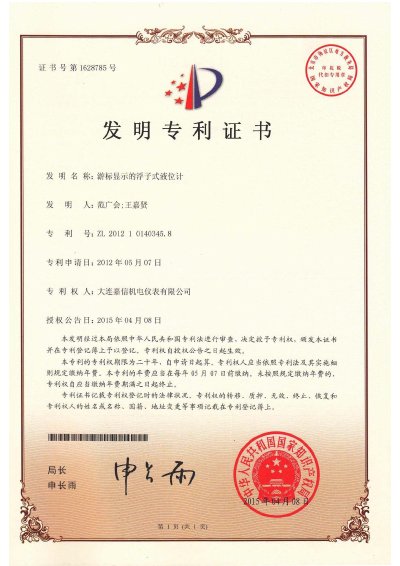
This is the granted Chinese invention patent CN 102645256 B (application 201210140345.8, filed 2012.05.07, granted 2015.04.08) for a "游标显示的浮子式液位计" — a float-type liquid level gauge with cursor display. The patentee named in the document is 大连嘉信机电仪表有限公司 (Dalian Jiaxin Electromechanical Instrument Co., Ltd.), with inventors 范广会 and 王嘉贤. The text states that the invention relates to the field of liquid level measurement.
The background section reviews existing local-indication level instruments (glass plate, magnetic flap/column, float and two-color water gauges) and earlier patents, arguing that sliding friction between float and float chamber reduces accuracy and sensitivity. The proposed gauge uses a non-ferromagnetic float chamber, a hollow spherical float of ferromagnetic material inside it, and a scale outside the chamber. The cursor consists of a cylindrical magnet with a central hole, a short shaft, a connecting rod and a counterweight; the magnet's cylindrical surface makes line contact with a flat face on the chamber wall that is parallel to the chamber axis, and rolls along it. The claims add a fixed pulley with a counterweight and connecting rope or belt, a transparent cursor chamber, thermal insulation at the cursor position, magnetically sensitive elements arranged near the magnet, a pointer on the connecting rod, a chamber made of plastic or glass, and corrosion-resistant linings or coatings. This manual is written in Chinese.
| Float chamber material | Non-ferromagnetic material |
|---|---|
| Float | Hollow spherical float of ferromagnetic material |
| Cursor magnet | Cylindrical magnet with a central hole on its axis |
| Magnet pole arrangement | Poles distributed along the axis, or on the radial inner and outer surfaces |
| Scale position | Outside the float chamber |
| Float chamber construction | Made of plastic or glass |
| Cursor contact | Magnet cylinder makes line contact with a flat face parallel to the chamber axis and rolls along it |
| Number of magnets | Two identical magnets mounted symmetrically at both ends of the short shaft |
The float chamber is made of a non-ferromagnetic material, and it can be made of plastic or glass. An anti-corrosion layer may be lined on its inner wall.
It uses a hollow spherical float made of ferromagnetic material, which may be covered with an anti-corrosion layer.
The cylindrical surface of the magnet makes line contact with a flat face on the chamber wall that is parallel to the chamber axis, and rolls along it in the axial direction.
The cursor includes a cylindrical magnet with a central hole, a short shaft, a connecting rod and a counterweight, with the center of gravity below the magnet's horizontal center line.