
A non-crystalline alloy far infrared heating element and heating band device are disclosed, which are applied in the field of far infrared heating. The non-crystalline alloy far infrared heating element comprises a heating element, an insulating layer, and a protective outer shell. The insulating layer is wrapped around the heating element. The protective outer shell is wrapped around the insulating layer. The heating band device comprises: a non-crystalline alloy far infrared heating element, a shield layer and a power connection lead. The shield layer wraps the insulating layer of the non-crystalline alloy far infrared heating element. The power connection lead is used to connect the two ends of the heating element of the non-crystalline alloy far infrared heating element. The invention heats the heating element to improve the thermal to electrical conversion efficiency and heat conversion performance. Moreover, the protective outer shell is wrapped around the insulating layer, which makes the outdoor application products have a safer and more reliable double-layer insulation structure, and can also play a good role in corrosion resistance and wear resistance, making it have a wider range of applicability and longer service life.
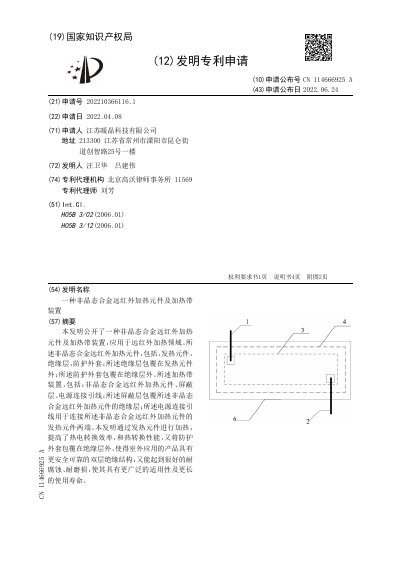
This is a Chinese invention patent application (publication CN 114666925 A, filed 2022-04-08, published 2022-06-24) from Jiangsu Nuanjing Technology Co., Ltd. It describes an amorphous alloy far-infrared heating element made of a heat-generating element, an insulating layer that covers it, and a protective outer sheath over the insulating layer. The heat-generating element uses an amorphous thin strip; the insulating layer is PE or PVC and is formed by extrusion over the heating element, while the outer sheath is PO or XLPE and is intended for outdoor products.
The application also describes a heating band device that adds an aluminum foil shielding layer over the insulating layer and power connection leads (a positive and a negative lead) that connect the two ends of the heat-generating element to an external power source in a closed circuit. The drawings show a two-pin plug for an indoor version and a three-pin plug with a ground wire for an outdoor version, where the sheath, shielding layer and insulating layer are stripped at both ends before the leads and ground wire are welded. The stated effects are higher electro-thermal conversion, a double insulating structure for outdoor use, and better corrosion and wear resistance. This manual is written in Chinese.
| Heat-generating element | Amorphous thin strip |
|---|---|
| Insulating layer material | PE (polyethylene) or PVC (polyvinyl chloride) |
| Protective outer sheath material | PO (polyolefin) or XLPE (crosslinked polyethylene) |
| Insulating layer forming method | Extruded onto the outside of the heat-generating element by an extruder |
| Shielding layer | Aluminum foil shielding layer |
| Power connection leads | One positive lead and one negative lead |
The insulating layer uses PE (polyethylene) or PVC (polyvinyl chloride).
It is an aluminum foil shielding layer that covers the insulating layer of the heating element.
It consists of the amorphous alloy far-infrared heating element, a shielding layer and power connection leads.
It is formed by extrusion with an extruder onto the outside of the heat-generating element.