
Siegling industrial belts can be used in the paper, cardboard and printing industry. They have stable friction performance, belt coating that protects the paper surface, good release and holding performance, and long service life, which helps to control quality and efficiency.
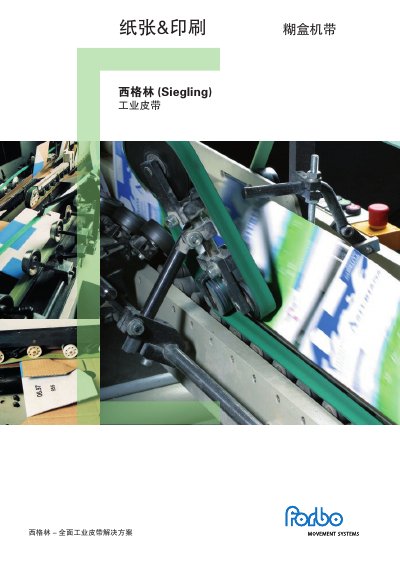
This Forbo Siegling leaflet presents the company's folder-gluer belts and conveyor belts for the paper, paperboard and printing industries. It lists belt properties such as stable friction, coatings that protect paper surfaces, good release and grip, and long service life, and it points to related Siegling publications on Transilon conveyor and processing belts, Extremultus flat belts, Linpack folder-gluer belts and machine roll coverings.
The E and A series use polyester or aramid tension layers with very low installation elongation, and most types are joined with a single-ply toothed splice that needs no additional material; Forbo Siegling offers a Z-punch PP-ZP-V/40-3 and heating clamps SM-HC-50/40, SM-HC-50/80 and SM-HC-80/60 for assembly. The P series is joined continuously with a bonded wedge splice. A technical data table gives type, part number, total thickness, minimum pulley diameter, Fw value and weight per square meter for each belt, with notes on minimum pulley diameter and on the meaning of the Fw value. This manual is written in Chinese.
| E series tension layer | Thermoplastic with polyester fabric warp and weft |
|---|---|
| A series tension layer | Thermoplastic with highly modular blended fabric (aramid warp) |
| P series construction | Polyamide belt with high tracking |
| Splicing, P series | Bonded wedge splice for continuous joining |
| Splicing, other types | Usually a single-ply toothed splice |
| Assembly equipment | Z-punch PP-ZP-V/40-3; heating clamps SM-HC-50/40, SM-HC-50/80, SM-HC-80/60 |
| Fw value definition | Shaft load at 1% elongation, measured in N/mm of belt width |
| A series belt example | UU 15A-17 FSTR/FSTR, 1.7 mm thick, 60 N/mm |
It is the shaft load at 1% elongation, measured in N/mm of belt width, and it directly shows belt tension.
They are joined continuously with a bonded wedge splice.
They are usually joined with a simple and precise single-ply toothed splice that is uniformly joined.
The E series uses polyester and the A series uses aramid.