
This manual introduces the basic use of DCS210PC single photon counter, mainly including unpacking inspection, product introduction, instrument principle, instrument function introduction, structure and operation method, and auxiliary product introduction.
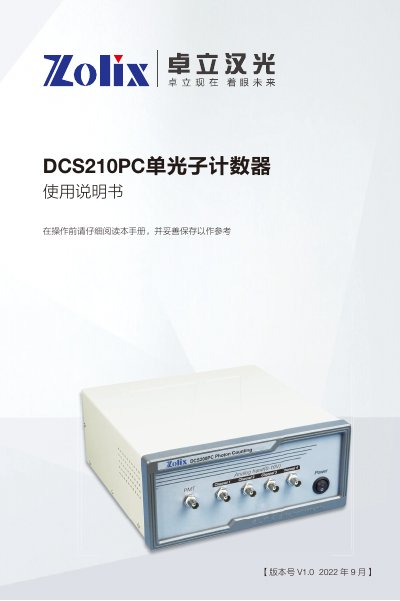
This user manual provides instructions for operating the DCS210PC single photon counter, including safety precautions, unpacking checks, instrument principles, and operational methods. It details features such as chopping mode and lifetime measurement for enhanced signal-to-noise ratio in scientific applications.
The device includes three analog input channels (16-bit, 0–10V), one analog output channel (12-bit, 0–10V), and USB connectivity. It is designed for high-resolution spectroscopy and nonlinear optics, with specifications including a 100 Mcps photon counting rate and a 1µS response width. This manual is written in Chinese.
| Photon Counting Rate | 100 Mcps |
|---|---|
| Analog Input Channels | 3 channels (0~10V, 16 bits) |
| Analog Output Channel | 1 channel (0~10V, 12 bits) |
| Trigger Method | External TTL and software trigger |
| Chopper Mode | Improves signal-to-noise ratio |
| Lifetime Measurement Range | 10µS to 10S |
| Instrument Response Width | 1µS |
| Dimensions | 240mm × 240mm × 150mm |
| Power Supply | AC110V/220V |
The photon counting rate is 100 Mcps.
It has three analog input channels with 0–10V range and 16-bit resolution.
The chopping mode enhances signal-to-noise ratio by subtracting background noise during alternating gate periods.
The lifetime measurement range is 10µS to 10S with a 1µS response width.