
Xtimate® SEC-700Å is a gel-based volume exclusion chromatography column with special surface modification technology to ensure the stability and batch repeatability of the packing. The packing is composed of a hydrophilic polymer bonded to a di-hydroxyl group of a rigid spherical silica microsphere. The double bonding mechanism makes the non-specific adsorption of water-soluble macromolecules, proteins, enzymes, peptides and other biological samples small, so it can be widely used in the separation and measurement of water-soluble polymers and biological macromolecules. It is one of the most common SEC analysis columns on the market and can replace SRT SEC-150, TSK gel 2000 SWxl, PROTEIN KW-802.5 and other brands of similar products.
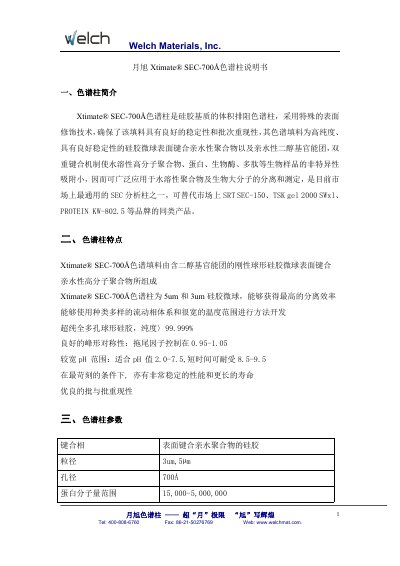
The Xtimate SEC-700Å is a silica-based size-exclusion chromatography column from Welch Materials. Its packing consists of rigid spherical silica microspheres surface-bonded with a hydrophilic polymer and hydrophilic diol groups, and the manual describes its use for separation and determination of water-soluble polymers and biological macromolecules such as proteins, enzymes and peptides.
The document lists column features and parameters, then describes new-column activation with 80% methanol water and pure water, daily maintenance including sample and mobile-phase filtration and flushing, buffer-salt handling, short- and long-term storage, and pH precautions. This manual is written in Chinese.
| Bonded phase | Silica surface bonded with hydrophilic polymer |
|---|---|
| Particle size | 3 µm and 5 µm |
| Protein molecular weight range | 15,000–5,000,000 |
| Water-soluble polymer molecular weight range | 2,500–500,000 |
| Maximum pressure | 4500 psi |
| pH stability | 2.0–7.5; short-term tolerance 8.5–9.5 |
| Salt concentration range | 20 mM–2.0 M |
| Optimum temperature | 40°C; maximum 80°C |
| Mobile phase compatibility | Conventional aqueous and organic solvents |
The manual states it is widely used for separation and determination of water-soluble polymers and biological macromolecules such as proteins, enzymes and peptides.
The recommended pH range is 2.0–7.5, with short-term tolerance to 8.5–9.5.
Flush with 80% methanol water and pure water at 0.5 mL/min for 5 hours each, then equilibrate with the analysis mobile phase.
Buffer-salt solution should not remain in the column overnight.