
Protect RCS DC systems are designed to provide highly reliable power and battery charging capabilities.
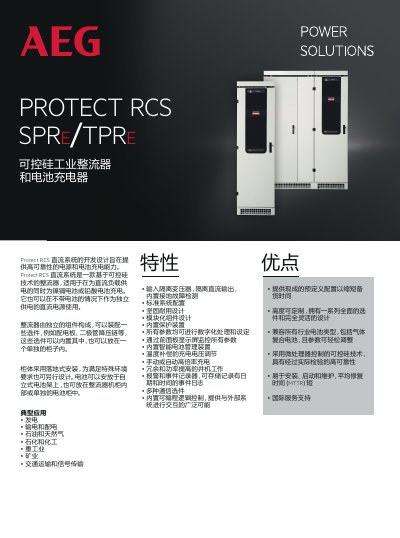
The AEG Power Solutions Protect RCS SPRe/TPRe is a thyristor-based rectifier system that supplies DC loads and charges nickel-cadmium or lead-acid batteries, and can also be used as a stand-alone DC power supply without a battery. The rectifier is built from separate modular components, and options such as distribution boards and diode dropping chains can be fitted inside the cabinet or placed in a separate cabinet; cabinets are floor-standing.
The leaflet covers typical applications (power generation, transmission and distribution, oil and gas, petrochemical and chemical, heavy industry, mining, transport and signaling), the standard configuration, the available system, alarm, control, communication and mechanical options, and product specifications. SPRe designates the single-phase series and TPRe the three-phase series, with DC output voltages of 24, 48, 60, 110, 125 and 220 V and output currents up to 1,200 A listed in the current table. This manual is written in Chinese.
| Rated input voltage, single-phase (SPRe) | 220 V / 230 V / 240 V ±10 % (+15 % – 20 % normal operation) |
|---|---|
| Rated input voltage, three-phase (TPRe) | 380 V / 400 V / 415 V ±10 % (+15 % – 20 % normal operation) |
| Input frequency | 50 Hz or 60 Hz, ±6 % |
| Power factor | SPRe ~0.67; TPRe ~0.81 |
| Output voltage (UDC) | 24, 48, 60, 110, 125, 220 V DC |
| Static voltage output accuracy | ±0.5 % for float charge, 0–100 % DC load change, input voltage ±10 %, frequency ±6 %, 0 °C to 40 °C |
| DC ripple voltage with battery connected | Max. 2 % of rated input voltage (standard battery capacity 5 times charging current) |
| Charging characteristic | Constant current / constant voltage in float charge (I/U according to IEC 478-1) |
| Insulation resistance | >200 MΩ / 500 VDC |
| Input/output insulation | 2,500 V AC |
| Degree of protection | IP21 according to IEC 60529 |
| Enclosure color | RAL 7035, textured powder coating |
| Noise at 1 m | 45 – 65 dB(A) |
| Operating temperature | 0 °C to +40 °C; 1.25 % output derating per 1 °C from 40 °C to 55 °C |
| Storage temperature | -25 °C to +70 °C |
| Operating humidity | 10 % to 95 % relative humidity, non-condensing |
| Installation altitude | 0 to 1,000 m; 1 % output derating per 100 m between 1,000 m and 3,000 m |
| Electromagnetic compatibility | IEC/EN 61000-6-2, IEC/EN 61000-6-4 |
| Approvals and certifications | CE certification; NFC58-311 certification (gas recombination batteries) |
Yes. It can be used as a stand-alone DC power supply without a battery.
Nickel-cadmium or lead-acid batteries; the leaflet states compatibility with all industry battery types, including gas recombination batteries.
RS232/RS485 interfaces, RS232/RS485 Modbus protocol, TCP/IP, protocol conversion (Profibus DP, J-bus DNP3, IEC 61850), monitoring and management software, and redundant communication interfaces.
IP21 externally and IP20 with the door open.