
EDTA decalcifying solution is a liquid used for decalcifying bone tissue, teeth, etc. It can combine with the outer layer of calcium in hydroxyapatite crystals to form soluble non-ionic compounds, and at the same time promote the transfer of bound calcium in the inner layer of crystals to the outside. Using this continuous action to gradually dissolve hydroxyapatite crystals, pH neutral when it can chelate. Its characteristics are long decalcification time, little damage to bone tissue, and better preservation of enzyme activity (alkaline phosphatase) and cell antigens. The slides made can be used for histochemical and immunochemical analysis.
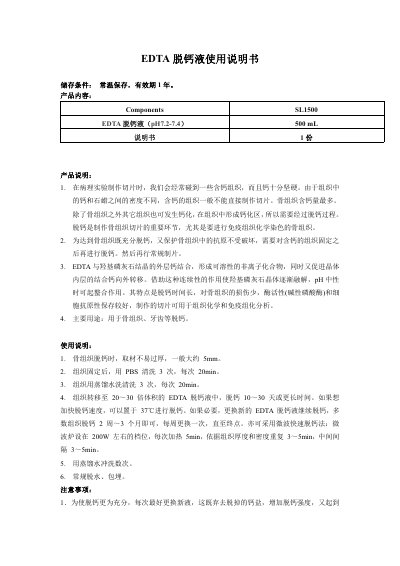
This manual provides instructions for the SL1500 EDTA decalcifying solution, a reagent used for decalcifying bone and tooth tissues to facilitate sectioning for pathological experiments. The solution is designed to protect antigen activity, making it suitable for histochemical and immunohistochemical analysis. It works by forming soluble non-ionic compounds with calcium in hydroxyapatite crystals, gradually dissolving them at a neutral pH. This manual is written in Chinese.
| pH Range | 7.2-7.4 |
|---|---|
| Volume | 500 mL |
| Storage Condition | Room temperature |
The tissue should not be too thick, generally around 5mm.
Most tissues require 2 weeks to 3 months, though it can take longer depending on the tissue.
Yes, microwave decalcification can significantly shorten the time, using intermittent heating at 200W.