
This document is the EA-MINI-SUB-1D-100 user manual
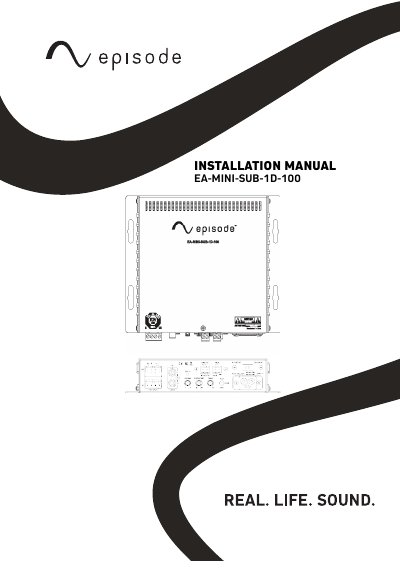
The EA-MINI-SUB-1D-100 is a subwoofer amplifier documented in this installation manual from Snap One. The manual provides important safety instructions, identifies the amplifier's controls and connections, and explains setup, mounting, and wiring.
It also describes fine tuning with three EQ presets for different enclosure air volumes, plus crossover, phase, volume, and LFE settings. The document includes English safety instructions and a French translation of the safety section.
| Input Voltage Settings | 120V or 230V |
|---|---|
| Maximum Ambient Temperature | 35°C |
| EQ Preset A | +4dB (enclosures > 4 cu. ft.) |
| EQ Preset B | +7dB (enclosures 1-4 cu. ft.) |
| EQ Preset C | +10dB (enclosures < 1 cu. ft.) |
| Speaker Wire Gauge | 14-18 gauge stranded two-conductor |
| Minimum Subwoofer Impedance in Parallel | 8Ω |
Red means AC power is present but the amplifier is in standby mode; blue means power is on and a signal is being received.
Use the L (left) channel for an LFE connection.
Use 14-18 gauge stranded two-conductor speaker wire.
The voltage selector can be set to 120V or 230V.