
A light energy collimator is provided, which is used to receive light energy information of a specified area on the road through an image receiving device. The light energy collimator can improve the accuracy of light energy reaching the specified area at night, screen off all light outside the target area, and thereby improve the accuracy of far-beam or oncoming far-beam light capture, and improve the capture efficiency and effect of vehicles that do not use far-beam lights according to regulations.
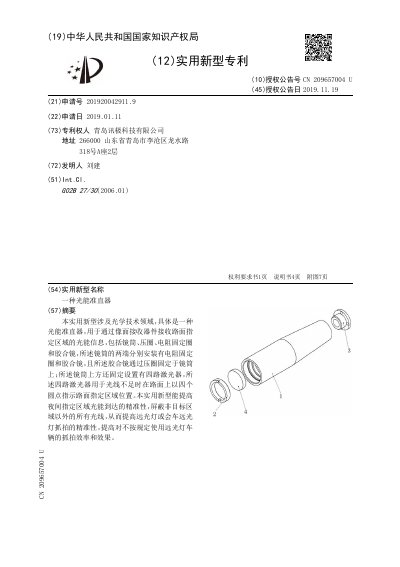
This is a Chinese utility model patent (publication CN 209657004 U, application 201920042911.9, filed 2019.01.11 and published 2019.11.19) held by Qingdao Xunji Technology Co., Ltd. It describes a light energy collimator that uses an image-plane receiver to collect light energy information from a designated area of the road. The device consists of a lens barrel, a pressing ring, a resistor fixing ring and a glued lens, with the glued lens held on the barrel by the pressing ring.
Four lasers are mounted above the lens barrel; when light is insufficient they project four dots on the road surface to indicate the designated area. The patent states that the collimator improves the accuracy of light reaching the target area at night, blocks light from outside the target area, and thereby improves capture of vehicles using high beams. The text gives optical characteristics, a lens material and aperture table, a laser positioning system, and a traffic management system that includes the collimator. This manual is written in Chinese.
| Field of view | 2° × 0.4° |
|---|---|
| Aperture stop diameter | 15 mm |
| Wavelength range | 0.4 µm – 0.65 µm |
| Center wavelength | 0.587 µm |
| Image height | 2.62 mm × 0.54 mm |
| Glued lens aperture and material | 15 mm, H-K9L or H-F2 |
| Image-plane receiver | 5 mm × 5 mm photoresistor |
| Installation height | 6 m – 7 m above ground |
| Target area on road | 3.5 m × 10 m rectangle |
| Laser power and dot size | 700 MW, four 8 cm dots at 50 m – 100 m |
It receives light energy information from a designated area of the road through an image-plane receiver, and can be used in traffic management.
When light is insufficient, they mark the designated road area with four dots; the dots are 8 cm in diameter and indicate an area 50 m to 100 m away.
It is mounted 6 m to 7 m above the ground to receive light from a 3.5 m × 10 m rectangular area of the road.
The receiver is a photoresistor with a format of 5 mm × 5 mm.