
A TPR shoe sole special mold, comprising an upper external mold and a lower external mold. The upper external mold is fixedly connected with an inner mold. The inner wall of the inner mold is slidably installed with a lift plate. The outer top wall of the upper external mold is provided with a screw. The bottom end of the screw is threaded through the top wall of the upper external mold and the top wall of the inner mold and extended to the inner part of the inner mold to rotately connect to the top side of the lift plate. The lower outer mold has a lower inner mold slidably installed in the groove and the lower outer mold has a mounting groove at the bottom of the groove. The lower inner mold has a limit block fixedly connected at one end of the bottom side. The limit block has a limit hole. The side wall of the mounting slot is provided with a limit slot near the limit block.
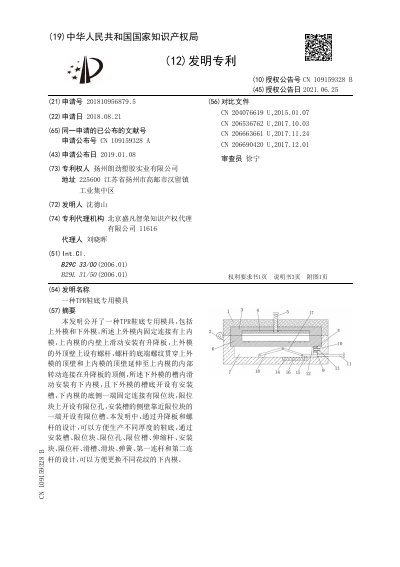
This document describes a specialized mold for manufacturing TPR (thermoplastic rubber) shoe soles. The invention addresses limitations in existing molds that have fixed shapes and cannot adjust sole thickness or easily change patterns.
The mold consists of an upper outer mold and a lower outer mold, each containing an inner mold. Key features include a lifting plate and screw mechanism to adjust the thickness of the sole cavity, and a linkage system with a telescopic rod to facilitate the removal and replacement of the lower inner mold with different patterns. This manual is written in Chinese.
It is designed to produce TPR shoe soles with adjustable thickness and interchangeable bottom molds to reduce production costs.
By turning the screw, which moves the lifting plate up or down to change the cavity thickness between the upper and lower molds.
The installation slot, limit block, limit hole, limit groove, telescopic rod, mounting block, limit rod, sliding groove, sliding block, spring, first connecting rod, and second connecting rod.