
HT-IMU-500 is a small, high-precision MEMS inertial measurement unit, which integrates three-axis high-precision MEMS gyroscopes, three-axis high-precision MEMS accelerometers, and the product is factory-calibrated before full temperature compensation to ensure its stability in complex temperature environments. It is widely used in intelligent transporting robots (AGV), autonomous underwater vehicles (AUV), industrial equipment, surveying/mapping, stable platforms, transportation, unmanned aerial vehicles (UAVs), and unmanned ground vehicles (UGVs) etc.
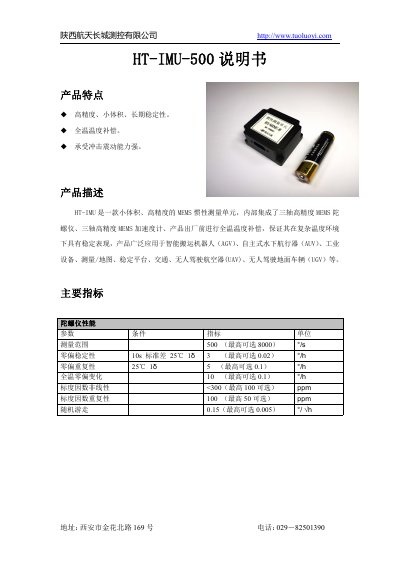
The HT-IMU-500 is a compact, high-precision MEMS inertial measurement unit integrating three-axis gyroscopes and accelerometers. It features full-temperature compensation for stable performance in harsh environments. Applications include AGVs, AUVs, UAVs, UGVs, and industrial equipment.
The unit outputs data via RS422 at 921.6Kbps, with configurable update rates up to 2000Hz. It operates from -40°C to +80°C and measures 38.6×44.8×21.5mm with a weight of 65g. This manual is written in Chinese.
| Gyro Measurement Range | 500 °/s (up to 8000 °/s) |
|---|---|
| Gyro Zero Bias Stability | 25℃ 1δ 3 °/h (up to 0.02 °/h) |
| Accelerometer Range | ±10, ±20, ±40 g |
| Data Interface | RS422, 921.6Kbps |
| Operating Temperature | -40°C to +80°C |
| Dimensions | 38.6×44.8×21.5mm |
Up to 2000Hz.
From -40°C to +80°C.
RS422 with 921.6Kbps baud rate, no parity, 8 data bits, 1 stop bit.