
IJSR-4000 JM03G is inkjetable solder resist ink with the following features: Excellent adhesion to laminate with dual cure (UV + Thermal) process Tack free right after printing due to On-head UV lamp on inkjet head, which provides excellent processability
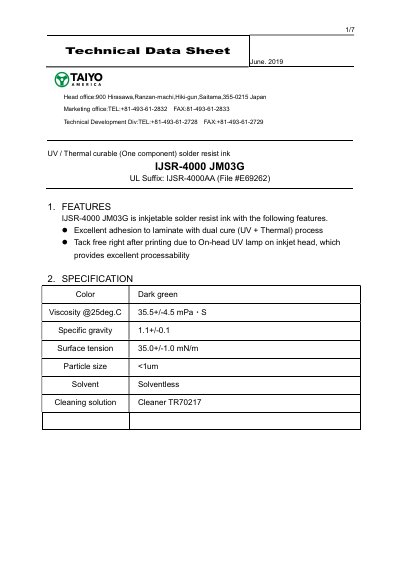
Taiyo Ink IJSR-4000 JM03G is a one-component solder resist ink cured by UV and thermal processes. It is dark green, solventless, and becomes tack free right after printing using an on-head UV lamp, which supports inkjet processability.
The ink is applied with piezo inkjet printers on FR-4 laminate or copper foil at a coating thickness of 35+/-5um. Standard processing includes UV pre-curing, thermal curing at 150deg.C for 60 minutes, and UV bump curing, and the product meets IPC-SM-840E Class H and T requirements.
| Color | Dark green |
|---|---|
| Viscosity @25°C | 35.5+/-4.5 mPa·S |
| Specific gravity | 1.1+/-0.1 |
| Surface tension | 35.0+/-1.0 mN/m |
| Particle size | <1 um |
| Cleaning solution | Cleaner TR70217 |
| CTI | ≥600 |
| Halogen level | < 50 ppm |
The recommended head is KM1024i SHE Konica Minolta.
Curing uses UV pre-curing, thermal curing at 150deg.C for 60 minutes, and UV bump.
Yes, the halogen level is below 50 ppm.
The coating thickness is 35+/-5um.