
This manual is the operating manual for Valeport's Hyperion Optical Sensor, which introduces the sensor's function characteristics and usage methods
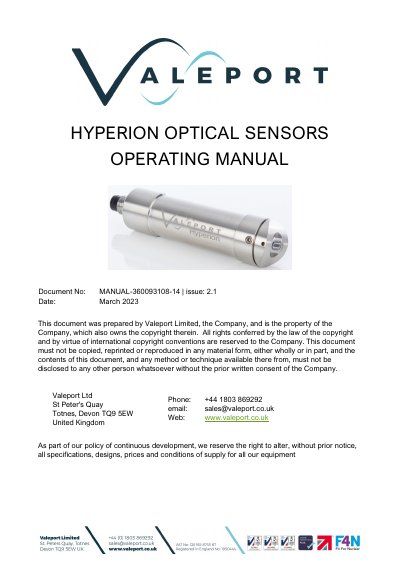
The Valeport Hyperion is a compact, robust optical instrument designed for high-performance measurements of fluorophores such as Chlorophyll a, Fluorescein, Phycocyanin, Rhodamine WT, and Sulforhodamine B, as well as Turbidity. It features a titanium housing rated for 6000m depth and supports RS232, RS485, and Modbus RT communication protocols. The sensor can operate as a standalone unit or be integrated into Valeport's SWiFT, rapidPro CTD, and fastCTD profilers.
| Depth Rating | 6000m |
|---|---|
| Power Supply | 9 - 28V DC |
| Data Output Rate | up to 16Hz |
| Communication Protocols | RS232, RS 485, Modbus RT |
| Chlorophyll a Excitation | 470 nm |
| Chlorophyll a Detection | 696 nm |
| Chlorophyll a Dynamic Range | 0-800 µg/l |
| Turbidity Excitation/Detection | 850nm |
| Turbidity Linear Range (Nephelometer) | 0 to 1 000 NTU |
| Turbidity Linear Range (Backscatter) | 0 to 4 000 NTU |
The Hyperion measures Chlorophyll a, Fluorescein (Uranine), Phycocyanin, Rhodamine WT, Sulforhodamine B, and Turbidity.
Yes, it can be integrated into Valeport's SWiFT, rapidPro CTD, and fastCTD profilers.
The response time is between 0.03 and 2 seconds.
Use warm soapy water with a soft bristled brush for light fouling, or a solvent like Isopropyl alcohol for heavy fouling, followed by a thorough rinse in fresh water.