
The manual introduces the HBLC, HBLT, HBSLC and HBSLT products' features and characteristics. These products can be used to measure liquids such as NH3, water, HFC/HFO refrigerants, CO2, hydrocarbons and alcohols. They can be installed in refrigeration systems and similar demanding systems.
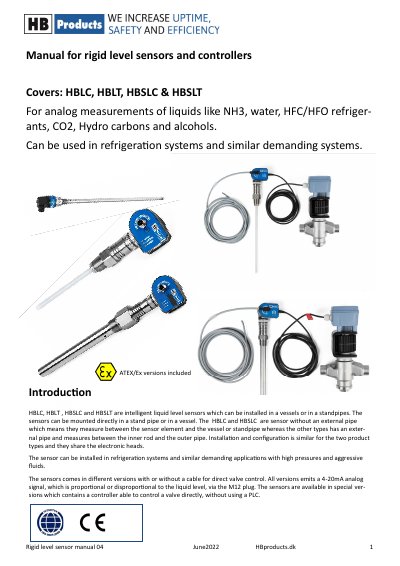
This manual covers installation, configuration, and operation of HBproducts' rigid level sensors HBLC, HBLT, HBSLC, and HBSLT. These sensors measure liquid levels in vessels or standpipes using 4-20mA analog signals and can be used in refrigeration systems with high pressure and corrosive fluids. Some versions include built-in controllers for direct valve control without a PLC. The manual includes safety instructions, connection diagrams, calibration procedures, and troubleshooting.
The sensors come in different configurations: HBLC and HBSLC have no external pipe and measure between the sensor element and vessel, while HBLT and HBSLT have an external pipe. Installation requires technical knowledge of refrigeration and electronics. Safety warnings are included for proper handling and to avoid damage from improper installation or welding.
| Analog Output | 4-20mA |
|---|---|
| Compatible Liquids | NH3, water, HFC/HFO refrigerants, CO2, hydrocarbons and alcohols |
The sensors can measure NH3, water, HFC/HFO refrigerants, CO2, hydrocarbons and alcohols.
The sensors are designed for measuring liquids such as ammonia, water, HFC/HFO refrigerants, CO2, hydrocarbons, and alcohols.
The sensor must have a minimum of 50 mm between the sensor end and the bottom of the pipe.
The sensor should be mounted on the vessel with a torque of 80-150 Nm.