
This is a maintenance manual that describes the maintenance methods of Milwaukee Valve RACK AND PINION PNEUMATIC ACTUATORS
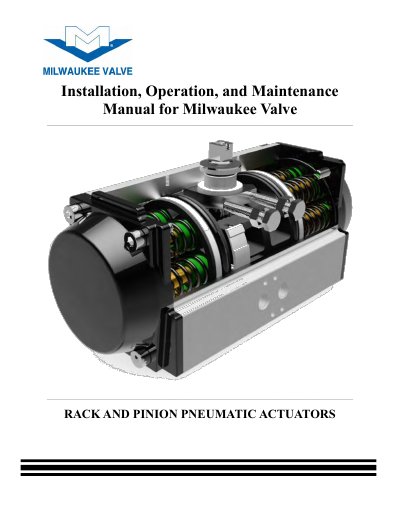
This document serves as the 1st edition installation, operation, and maintenance manual for Milwaukee Valve RACK AND PINION pneumatic actuators, issued in March 2015. It details the identification, specifications, and operational principles for both Double Acting and Spring Return models. The guide explains how these actuators operate with pressurized air (or hydraulic fluid, water, or inert fluids) within a pressure range of 20 PSIG to 150 PSIG.
| Operating Pressure Range | 20 PSIG to 150 PSIG |
|---|---|
| Operating Fluids | Pressurized air, hydraulic fluid, water, inert fluids |
| Standard Temperature Range | -20° to 80° C |
| High Temperature Range | -15° to 160° C |
| Low Temperature Range | -50° to 70° C |
| Factory Lubrication Cycles | 2,000,000 cycles |
Yes, double acting and spring return actuators can be easily field converted by inserting or removing unique, patented spring cartridges.
The standard operation is counterclockwise to open and clockwise to close, referred to as a 'fail clockwise' (FCW) or 'fail closed' configuration.
Yes, air must be allowed to enter and exit through Port B unobstructed for proper operation, even though only Port A needs pressurization.