
this is a bridge design standard document
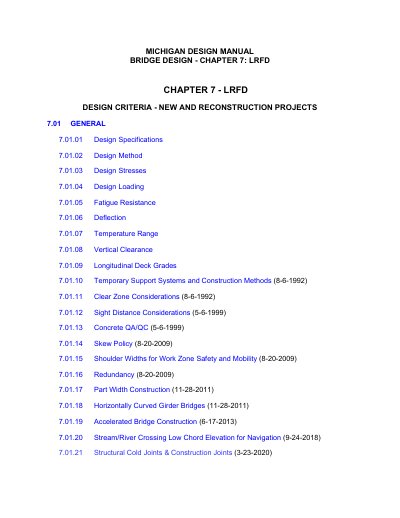
This chapter establishes the Load and Resistance Factor Design (LRFD) criteria for bridges in Michigan carrying vehicular traffic, based on the AASHTO LRFD Bridge Design Specifications with Michigan-specific modifications. It covers general design requirements, superstructure and substructure design, steel reinforcement, pedestrian and railroad fencing, reconstruction projects, approach items, and utility accommodations.
The document specifies design stresses for concrete, steel reinforcement, structural steel, prestressed concrete, and foundation piling. It defines design loading for interstate/trunkline routes (HL-93 Mod), local roads, pedestrian/bicycle bridges, and railroad bridges. Additional criteria address fatigue resistance, deflection limits, temperature ranges, and future wearing surface loads.
Bridges in Michigan carrying vehicular traffic are designed according to the current edition of the AASHTO LRFD Bridge Design Specification, with exceptions presented in this Design Manual.
Vehicular live loading on interstate and trunkline bridges uses HL-93 Mod loading, which consists of 1.2 times the combination of the design truck or single 60 kip load and the design lane load.
Grade 3500HP and 4500HP concrete are used in all trunkline projects in Metro, University, Grand, Bay, Southwest and North Regions.
All new bridges and bridge replacements shall be designed for a future wearing surface load of 25 LBS/SFT.