
This manual introduces the working principle, installation, maintenance and calibration of 288A differential pressure indicating switch
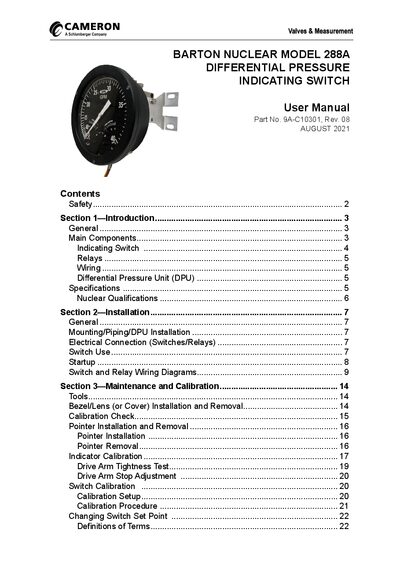
The Barton 288A is a weather‑proof differential pressure indicating switch housed in a NEMA‑4 watertight aluminum case with a large cover lens for easy reading. It features adjustable single or dual alarm switches, optional relays, and a built‑in Differential Pressure Unit (DPU) for nuclear‑qualified applications.
The manual is organized into sections covering safety warnings, an introduction to the device, detailed installation instructions, wiring diagrams, calibration and maintenance procedures, parts lists, dimensional drawings, and appendices for the Model 224 DPU. It also includes specifications, nuclear qualification details, and warranty information.
| Switch Contact Rating | 5.0 A @ 250 VAC, 50/60 Hz |
|---|---|
| Relay Contact Rating | 10 A @ 150/250 VAC |
| Switch Repeatability | ±0.25 % of full scale |
| Switch Deadband | ±5 % (SPDT); ±6 % (DPDT) |
| Ambient Temperature Limits | -40 °F to +180 °F |
| Internal Wiring Gauge | 22 AWG |
| External Wiring Gauge | 18 AWG |
The switch contacts are rated for 5.0 amps at 250 VAC, 50/60 Hz.
Perform the Calibration Check procedure described on page 15 to verify the unit remains within factory‑set tolerances.
The device operates from –40 °F (–40 °C) up to +180 °F (+82 °C).
Internal wiring uses 22 AWG and external wiring uses 18 AWG.