
This document is the user manual of iCP - Intelligent Carriage Plate (Class II and III), which includes the installation, maintenance and other contents of the product.
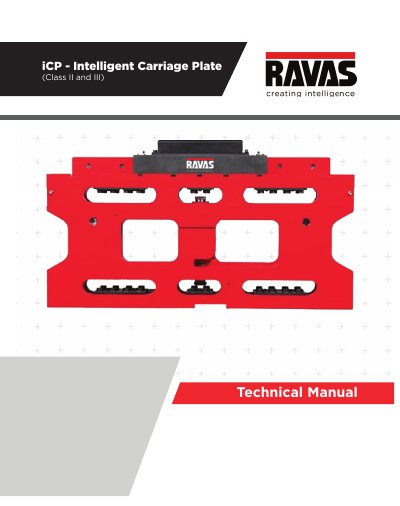
The manual provides warranty policy, contact details, and technical bulletins for RAVAS iCP intelligent carriage plates used on Class II and III lift trucks. It includes loss-of-lifting-capacity tables, safety bolt torque specifications, and warnings about safety bolt appearance.
Detailed installation steps cover unpacking, scale base mounting, indicator installation, and side-shift bracket attachment. Service procedures describe flexure replacement, load cell removal and reassembly, pre-load setting, heel-to-toe shift adjustment, and a 10-point weight distribution test with shimming instructions and a worksheet.
| Safety plate retaining bolt torque | 130 ft.-Lbs. |
|---|---|
| Flexure bolt torque | 130 ft.-Lbs. |
| Heel-to-toe weight difference tolerance | 1 Lb. |
| Class II capacity range | 3,000-6,000 Lbs. |
| Class III capacity range | 6,000-10,000 Lbs. |
| Total flexures per scale | 10 |
The correct torque value for safety plate retaining bolts is 130 ft.-Lbs.
Do not tighten them; safety bolts are designed to appear loose and maintain structural integrity in case of flexure failure.
There are ten flexures total: two in each outside pocket (top and bottom) and one in the center pocket (top and bottom).
The difference between heel and toe weights must be within 1 Lb. at each flexure position for the scale to be properly balanced.