
This document describes the processing methods of SPRINT® products.
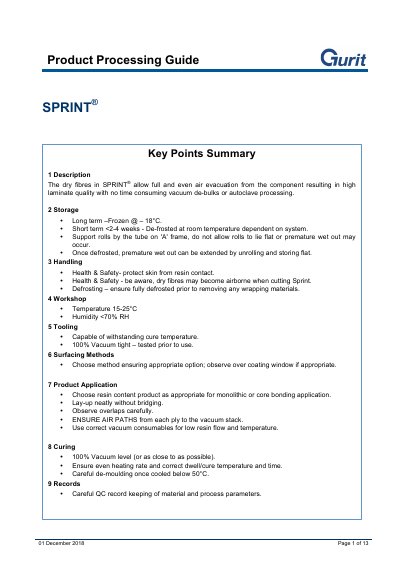
This guide explains how to process Gurit SPRINT® dry fibre composites, including storage requirements, handling precautions, workshop conditions, tooling specifications, surfacing methods, and curing procedures. It emphasizes maintaining vacuum integrity, controlling temperature and humidity, and using appropriate surfacing films and release agents to ensure high-quality laminates.
Key steps include defrosting materials before use, storing rolls properly to prevent premature wet-out, maintaining workshop temperatures between 15-25°C and humidity below 70% RH, and ensuring tooling is vacuum-tight and thermally stable for the intended cure cycle.
Long term storage requires freezing at -18°C. Short term storage (under 2-4 weeks) requires defrosting at room temperature.
Humidity should be kept below 70% RH to prevent condensation.
The vacuum level must exceed 90% (approx. 900 mbar) and vacuum drop should be less than 5% over 10 minutes.
Gurit offers films such as SF70, SF80, SF80FR OBL, SF96, and SF95 VH, each with specific weights, colors, and curing temperatures.