
Fusarium wilt and Verticillium wilt can cause serious losses in cotton yield. This article introduces the symptoms, occurrence patterns, and control methods of the two diseases.
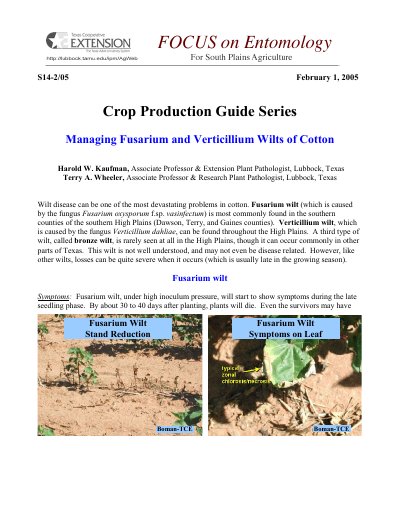
This document serves as a crop production guide for managing Fusarium wilt and Verticillium wilt in cotton. It details the symptoms, epidemiology, and management strategies for these diseases, which are caused by the fungi Fusarium oxysporum f.sp. vasinfectum and Verticillium dahliae, respectively. The guide highlights that Fusarium wilt is most common in the southern counties of the High Plains, while Verticillium wilt can be found throughout the region.
Fusarium wilt is caused by the fungus Fusarium oxysporum f.sp. vasinfectum.
Verticillium wilt is caused by the fungus Verticillium dahliae.
It increases immature fibers and decreases fiber length, strength, uniformity, and grade.