
This manual provides detailed instructions on the application of Dynesic Epoxy Coating, including application methods, how to prevent bubbling, how to prevent crystallization, and how to re-coat a bubbled surface.
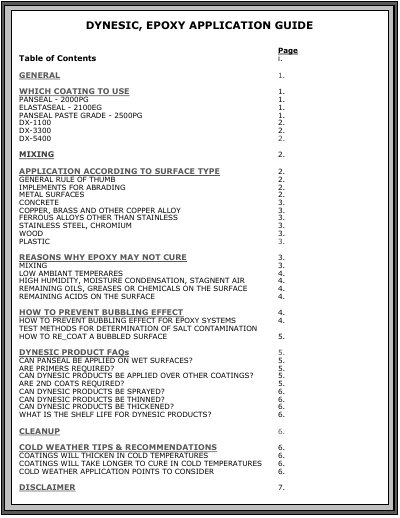
This document serves as an application guide for Dynesic epoxy coating systems, detailing the selection of specific products based on performance requirements such as abrasion resistance, flexibility, and chemical resistance. It explains that these two-part systems consist of an epoxy resin and a hardener, which must be properly mixed to achieve high strength and solvent resistance.
| PANSEAL Adhesion Strength | 2,750 PSI |
|---|---|
| PANSEAL Elongation | 8% |
| ELASTASEAL Elongation | greater than 300% |
| ELASTASEAL Adhesive Strength | 1600 psi |
| DX-1100 Coverage Rate | 300 to 350 square feet at 5 mils |
| New Concrete Curing Time | minimum of 7 days |
| Mortar Joints Curing Time | minimum of 15 days |
The document does not explicitly state if PANSEAL can be applied on wet surfaces, but it lists 'High Humidity, Moisture Condensation, Stagnent Air' as reasons why epoxy may not cure.
Dynesic coatings and sealant products are generally self-priming on most surfaces, though DX-1100 is recommended for concrete.
The document lists 'Can Dynesic Products Be Sprayed?' as a FAQ topic but does not provide the specific answer in the provided text.
The document lists 'What is the Shelf Life for Dynesic Products?' as a FAQ topic but does not provide the specific answer in the provided text.