
This is an autoEC Eddy Current Signal Conditioner that uses a USB interface. It supports 2-point, 6-point, and 21-point linear calibration, temperature compensation, digital filtering, and sample rate. It can be connected to a computer via a USB interface and used with the autoEC GUI software to perform calibration, record curves, and monitor devices.
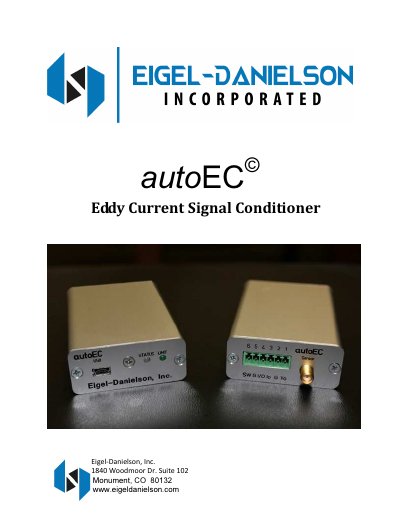
The autoEC is a digitally corrected eddy current signal conditioner designed to work with various eddy current sensors. It features USB connectivity for setup and calibration, and supports analog voltage and current outputs. The device can be calibrated using 2-point, 6-point polynomial, or 21-point piecewise linear methods, with options for temperature compensation. It is available in OEM configurations without an enclosure.
The manual provides step-by-step instructions for installing drivers, connecting sensors and outputs, configuring voltage/current ranges, and performing calibration. It also covers advanced settings like digital filtering and sample rate adjustments, with detailed explanations for each feature.
| Output Current Range | 0-20mA, 4-20mA |
|---|---|
| Sample Rate | 1 to 22,500 samples per second |
| Default Sample Rate | 10,000 samples per second |
| USB Interface | USB 2.0 |
The default sample rate is 10,000 samples per second.
Yes, the autoEC supports temperature compensation using proprietary algorithms and can improve temperature stability by a factor of 5-10 with additional steps.