
This manual describes the use of the IEPE-Link™ -LXRS® wireless IEPE sensor node. The node is used with the IEPE-Link™ gateway to create a wireless sensor network. This manual covers the node's components, interface, and indicators, as well as how to install and configure the node.
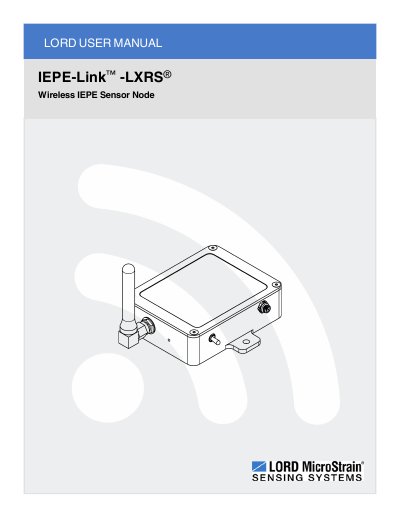
This user manual details the operation and configuration of the LORD MicroStrain® IEPE-Link™ -LXRS® wireless sensor node, designed for high-resolution vibration and shock monitoring using IEPE accelerometers. It covers system setup, software installation, node mounting, radio optimization, sensor connection, power management, troubleshooting, and maintenance. The node integrates with LORD’s gateway systems and software platforms like Node Commander® and SensorCloud™ for data collection and analysis.
The manual includes technical specifications for physical, operating, power, and radio performance, along with safety information and warranty details. It is intended for users installing and configuring wireless sensor networks for applications such as machine health monitoring, structural analysis, and vibration testing.
| Resolution | 24-bit |
|---|---|
| Sampling Rate | 1 kHz to 104 kHz |
| Dynamic Range | 109.5 dB |
| Connector Type | 10-32 mini-coaxial |
| Power Source | 2.3 mA constant current excitation |
| Radio Range | up to two kilometers |
It interfaces with IEPE sensors including accelerometers, strain gauges, pressure transducers, load cells, torque and vibration sensors, magnetometers, 4 to 20mA sensors, thermocouples, RTD sensors, soil moisture and humidity sensors, inclinometers, and orientation and displacement sensors.
The LORD MicroStrain® Node Commander® software is used for node configuration and data collection, and the optional SensorCloud™ web platform for data visualization and analysis.
The node supports sampling rates from 1 kHz to 104 kHz.
The node has a 109.5 dB dynamic range.