
Best Practice Poppy Growing Guide

This document is about the best practices for poppy cultivation, including purpose, varieties, planting methods, and harvesting.
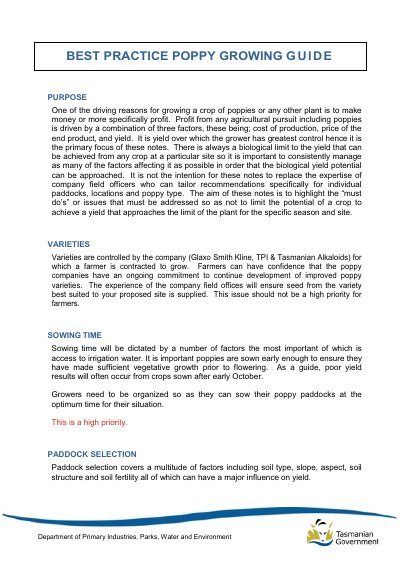

Best Practice Poppy Growing Guide - cover page
Brand
GLAXOSMITHKLINE
Category
Agricultural Machinery
Document type
User Manual
Language
English
Pages
7
File format
PDF
File size
84 KB
Published
20 October, 2023
Updated
20 October, 2023
MD5 checksum
63EF0336AFE0BDADDC7A066252A0C2B3

About this manual

This document outlines the key factors for maximizing yield in poppy crops, focusing on biological limits and management practices. It emphasizes that yield is the primary focus, driven by production costs, product price, and yield, with the latter being the most controllable factor. The guide notes that it does not replace the expertise of company field officers who can provide tailored recommendations for specific sites and poppy types.

What's inside

  • Purpose
  • Varieties
  • Sowing Time
  • Paddock Selection
  • Soil type
  • Soil fertility
  • Seed bed preparation
  • Fertilisers
  • Seeding Rate
  • Sowing Method

Frequently asked questions

What is the minimum depth of topsoil required for poppies to grow well?

Poppies grow best if they have at least 250mm of topsoil for their root system.

What is the ideal soil pH level for growing poppies?

The soil pH should be at least 5.8 when measured using the water extraction method.

What plant density per square meter is the aim for seeding poppies?

The aim is to achieve a plant density of about 70 per square meter.

Download PDF (84 KB)

More GLAXOSMITHKLINE Manuals


View all GLAXOSMITHKLINE manuals →