
This document describes the MIXTRAN, DISTRIB, and INDIVINT SAS macros that implement a statistical method for estimating usual dietary intakes of a single dietary component, whether consumed daily or episodically. This method can be used for a variety of applications, including: estimating the distribution of usual food or nutrient intake for a population or subpopulation; predicting individual food or nutrient intake for use in a disease model; and evaluating the effects of individual covariates on food or nutrient consumption.
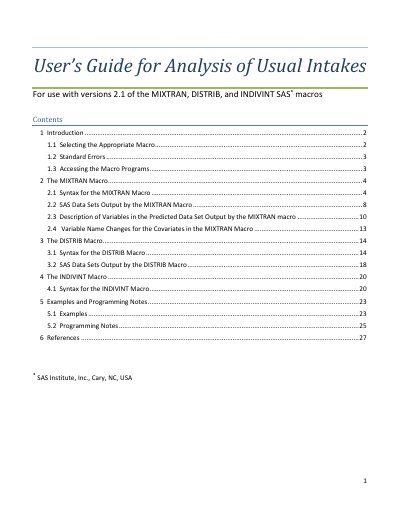
This user's guide describes the MIXTRAN, DISTRIB, and INDIVINT SAS macros that implement a statistical method for estimating usual dietary intakes of a single dietary component, whether consumed daily or episodically. The macros can perform a weighted analysis of survey data such as the National Health and Nutrition Examination Survey (NHANES).
The three model types are corr, nocorr, and amount.
The DISTRIB macro estimates the distribution of usual intake using parameter estimates and linear predictor values from the MIXTRAN macro.
The user must perform additional calculations, such as balanced repeated replication (BRR), to obtain standard errors and confidence intervals.