
This file is the user manual for B-WIC & B-SMC Impedance Test Fixtures products, which mainly introduces the safety instructions, intended use and operator qualifications of the products.
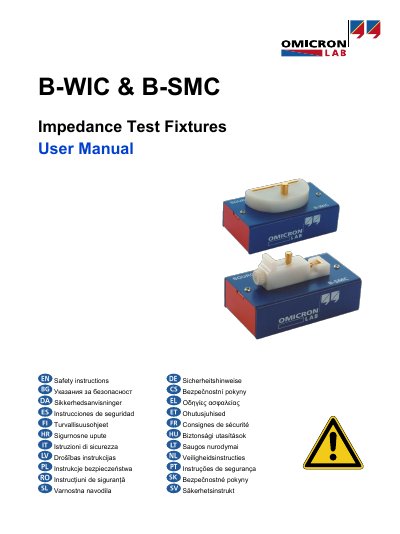
The OMICRON Lab B-WIC and B-SMC are impedance test fixtures designed for measuring passive components in laboratory or manufacturing environments. The B-WIC is intended for through-hole components, while the B-SMC is designed for surface-mount components. Both fixtures are specifically engineered to be used in conjunction with the Bode 100 vector network analyzer.
| Frequency range | 1 Hz to 50 MHz |
|---|---|
| Recommended impedance measurement range | 20 mΩ to 600 kΩ |
| B-CAL-3 load accuracy | 100 Ω ± 0.1%, 15 ppm/°C |
| Operating temperature | 5 °C … +40 °C |
| Dimensions (with connectors) | 100.5 mm x 68.2 mm x 55.5 mm |
| Weight B-WIC | 0.16 kg / 0.35 lbs |
| Weight B-SMC | 0.13 kg / 0.29 lbs |
The measurement principle is a relative voltage / current method where CH1 receives a voltage signal proportional to the voltage at the DUT and CH2 receives a voltage signal proportional to the current flowing thru the DUT.
Open / Short / Load calibration must be performed to compensate for parasitic effects and non-ideal behavior occurring at higher frequencies.
No, do not apply any external voltages or currents; they are SELV devices.