
This document is an instruction manual for Enardo Rim Vent D103825X012 Pressure Relief Valve.
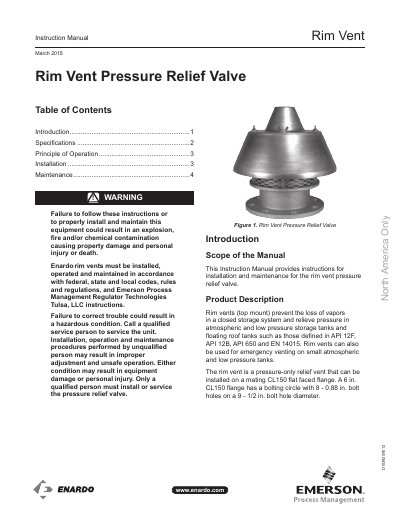
This manual provides step-by-step instructions for installing and maintaining the Enardo Rim Vent D103825X012 pressure relief valve. It covers safety warnings, installation methods for flanged pipes and tank roofs, pressure settings, and maintenance procedures. The valve is designed for atmospheric and low-pressure storage tanks, including floating roof tanks, to prevent vapor loss and relieve pressure.
The manual includes specifications such as pressure settings, flow rates, materials of construction, and assembly weights. It also details how to remove packing materials before operation and how to inspect and clean the sealing surfaces to ensure proper function.
| Connection Size | 6 in. / 150 mm |
|---|---|
| Flange Rating | CL150 |
| Pressure Setting | 0.5 to 12.0 oz./sq. in. |
| Materials of Construction | Cast Aluminum (Alloy 319-F) body, Aluminum (Alloy 3003-H14) hood, Polyphenylene Sulfide (PPS) pallet weights, Zinc Plated Carbon Steel rods |
The pressure setting range is 0.5 to 12.0 oz./sq. in.
Place the base gasket on the flanged pipe, line up bolt holes, place the rim vent on top of the base gasket, install nuts and bolts, and tighten in a circular manner.
The body is cast aluminum (Alloy 319-F), the hood is aluminum (Alloy 3003-H14), the pallet weights are polyphenylene sulfide (PPS), and the rods are zinc-plated carbon steel.
Scheduled maintenance should be performed at least once a year, or more frequently in corrosive or dusty atmospheres or if conditions warrant.